
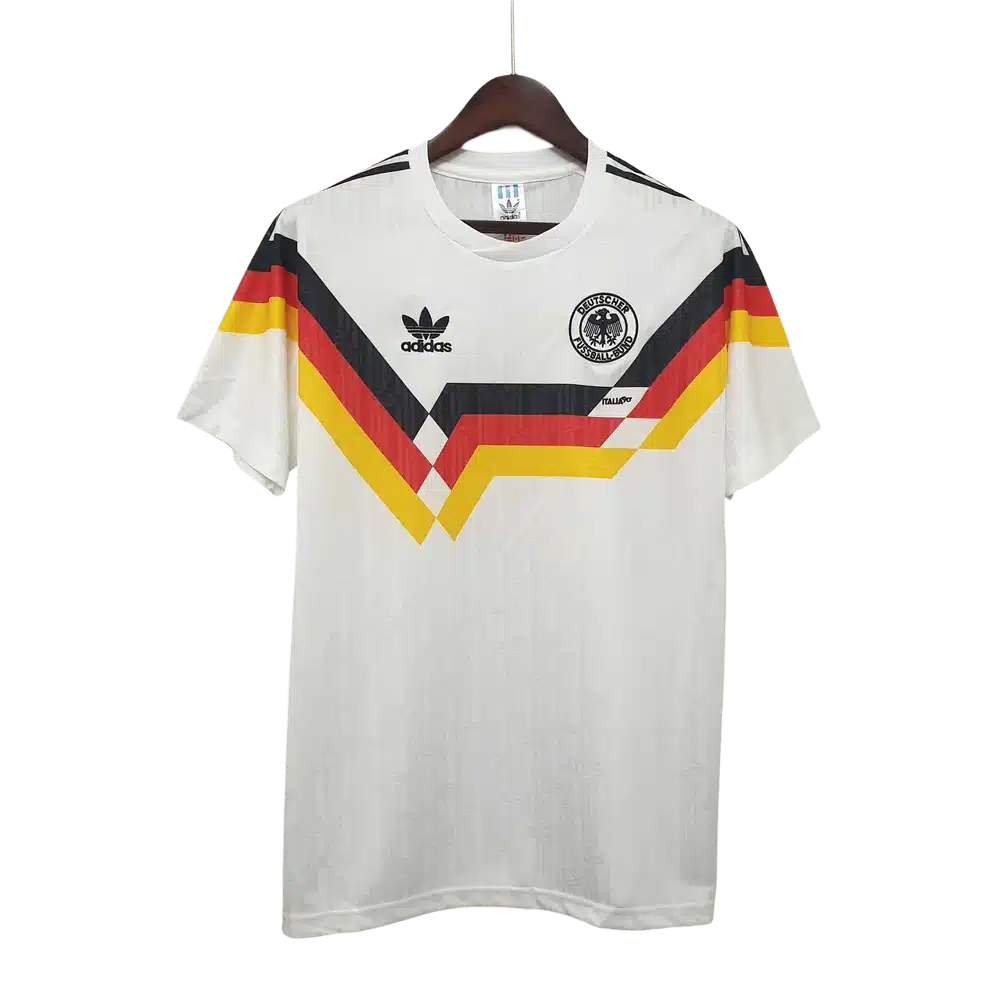
Germany’s 1990 World Cup shirt is one of the most recognisable football shirts ever made: a clean white base crossed by bold black, red and gold diagonal stripes. Worn in Italy in the summer of 1990, it has become shorthand for a golden moment in German football history, and for a style of shirt design that has never really gone away. This is the story of that shirt, why it looked the way it did, and why collectors and fans still love it today.
If you want the look for yourself, start with the Germany 1990 Retro Jersey at ElevenKick, a fan-inspired, premium-quality take on the classic Italia 90 design.
The team that travelled to Italy in 1990 played as West Germany. The tournament took place in June and July 1990, a few months before German reunification in October of that year. That timing gives the shirt a special place in history: it was the final World Cup shirt of the West Germany era, worn just as the country was on the brink of a profound change.
It was also a team full of experience and character. Lothar Matthaus captained the side, with Jurgen Klinsmann, Andreas Brehme and Rudi Voller among the leading players, and Franz Beckenbauer as coach. Beckenbauer had already won the World Cup as a player in 1974, and in 1990 he guided the team to the title again, this time from the sideline. The squad combined seasoned internationals with a clear, disciplined way of playing, and the shirt they wore became inseparable from that run.
German home shirts have almost always been white, and 1990 was no exception. What made this one different was the graphic that swept across the chest: thick diagonal bands in black, red and gold, the colours of the German flag, running from shoulder to waist. On a white background, the effect was striking without being fussy. You could spot the shirt from the far side of a stadium, and you can still spot it instantly in old photographs today.
That diagonal design mattered because it broke the habit of plain white shirts with only small trims. It kept the traditional base colour, but it gave the shirt a graphic identity of its own. The collar and sleeve trims stayed simple, which let the diagonal stripes do the talking. It was modern for 1990, yet it never tried to be outrageous, and that balance is a large part of why it has aged so well.
Retro shirts are often judged by how well they work away from the pitch, and this one passes that test easily. The white base goes with almost anything, the flag colours add character without clashing, and the bold diagonal keeps the shirt from looking like a plain white tee. It is a shirt that works at a match, at a retro football gathering, or simply as a piece of football history worn with jeans.
The 1990 World Cup in Italy is remembered for its atmosphere, its packed stadiums, and its dramatic knockout rounds. Germany progressed through the tournament with a blend of organisation, resilience and big-game experience, and reached the final in Rome. There, against Argentina, Andreas Brehme scored the only goal of the game from the penalty spot, and Germany lifted the trophy.
That final moment fixed the shirt in the memory of a generation. When fans picture Matthaus lifting the trophy, or Brehme standing over the ball, they picture the white shirt with the diagonal stripes. A shirt does not win a tournament on its own, of course, but it becomes the visual record of the achievement. Decades later, the shirt still tells that story at a glance.
First, it marks the end of an era. It is the last World Cup shirt of West Germany, worn in the year the country was reunified. Second, it marks the peak of a great team, captained by one of the finest midfielders of his generation and coached by one of the game’s most respected figures. Third, it is simply a great piece of design: bold, balanced and instantly recognisable.
It also helped to change what national team shirts could look like. After 1990, designers became more confident about using large graphics, diagonal patterns and flag-inspired colour blocks on international shirts. Not every experiment worked, but the Germany 1990 shirt showed that a national shirt could be both traditional and adventurous at the same time.
When fans talk about this shirt, they usually start with the diagonal stripes: their width, their order, and how cleanly they run across the chest. Next comes the fit and feel. Modern fan-inspired versions are made to be comfortable for everyday wear, with a relaxed replica fit rather than a tight match-day cut, so the shirt works as well off the pitch as it does in a collection.
Collectors also look at how the shirt pairs with other pieces. The white base makes it easy to wear with dark jeans, black shorts or a simple jacket, while the flag colours mean it never looks anonymous. If you are building a retro collection, it sits naturally alongside other classic World Cup shirts, but it also stands on its own as a single statement piece.
Keep the rest of the outfit simple and let the shirt lead. Dark denim and clean trainers are the easiest pairing, and they suit the shirt’s bold graphic without competing with it. For a matchday look, black shorts and white trainers echo the shirt’s original palette. In cooler weather, wear it under an open jacket or overshirt, with the diagonal stripes still visible at the chest.
Avoid overloading the outfit with other loud patterns or competing national colours. The shirt already has plenty of character, so plain, well-fitting basics around it give the best result. That is also why it works so well as a gift for a football fan: it is distinctive, it carries a real story, and it is easy to wear.
Some retro shirts are loved mainly by supporters of one club or country. The Germany 1990 shirt is loved more widely, because it combines a great tournament, a historic moment, and a design that still looks fresh. Whether you remember Italia 90 first-hand or discovered it through highlights and photographs, the shirt gives you a direct link to that summer.
Browse the ElevenKick shop to find fan-inspired retro shirts and classic national team styles, and add a piece of World Cup history to your collection.
We use cookies to improve your experience on our site. By using our site, you consent to cookies.
Manage your cookie preferences below:
Essential cookies enable basic functions and are necessary for the proper function of the website.
These cookies are needed for adding comments on this website.
Statistics cookies collect information anonymously. This information helps us understand how visitors use our website.
Marketing cookies are used to follow visitors to websites. The intention is to show ads that are relevant and engaging to the individual user.
You can find more information in our Cookie Policy and .