Before there was a modern idea of the complete footballer, there was Alfredo Di Stefano. The “Saeta Rubia” — the Blond Arrow — was a forward who seemed to play every position at once: scoring goals, defending, creating, and running the game from end to end. In the white shirt of Real Madrid, wearing the No. 9, he built the greatest club team the world had yet seen. This is the story of Di Stefano and the shirts he made famous.
Di Stefano was born in Buenos Aires in 1926 and began his career with River Plate, one of Argentina’s great clubs. He was a fast, powerful, intelligent forward with a remarkable engine. After a spell in Colombia with Millonarios of Bogota, where he starred in a team known as the “Blue Ballet”, he arrived in Spain in 1953 to join Real Madrid. It was one of the most important transfers in football history.
Real Madrid in the 1950s wore the all-white shirt that would become the most famous kit in club football. Di Stefano took the No. 9 and made it his own. What made him special was not just his goals, although he scored plenty of them. He was everywhere: dropping deep to collect the ball, driving forward with it, defending when the team lost it, and finishing moves he had started himself. Managers and teammates struggled to describe him, because no existing position quite covered what he did. He was, in the words of many who watched him, the first truly complete footballer.
Five European Cups in a row
Di Stefano’s Real Madrid achieved something no club has matched since. Between 1956 and 1960, Real Madrid won the first five European Cups — five in a row. Di Stefano scored in every one of those five finals, a record that still stands. The 1960 final against Eintracht Frankfurt at Hampden Park in Glasgow, which Real Madrid won 7-3, is remembered as one of the greatest club matches ever played. Di Stefano scored three goals that night, and his strike partner Ferenc Puskas scored four.
The partnership with Puskas is one of football’s great stories. The Hungarian, who arrived at Real Madrid in 1958, wore the No. 10, and together the two forwards formed a partnership of rare understanding. Puskas was the finisher with the thunderous left foot; Di Stefano was the engine who made everything work. Alongside them were players like Francisco Gento, the flying winger who won six European Cups, and Raymond Kopa, the elegant French playmaker. It was a team full of stars, and Di Stefano was its heart.
At home, the success was just as complete. Di Stefano won eight Spanish league titles with Real Madrid, and he was the league’s top scorer five times. He won the Ballon d’Or, the award for Europe’s best player, in 1957 and again in 1959. By the time he left the club in 1964, after eleven seasons, he had scored 308 goals in 396 appearances for Real Madrid. Those numbers, remarkable on their own, do not capture his real influence: he changed what a forward could be.
Three national teams
Di Stefano’s international career was unusual. He played for Argentina, then for Colombia in unofficial matches during his time with Millonarios, and finally for Spain after becoming a Spanish citizen. He never played at a World Cup, which remains one of football’s great what-ifs. Injuries and politics kept him away from the tournament, and it is the one gap in a career that had everything else. For collectors, that quirk makes his shirts even more interesting: the Argentina shirt, the Colombia shirt, and the Spain shirt all belong to the same extraordinary story.
His nickname, the Blond Arrow, came from his fair hair and his speed. Photographs from the 1950s show a player in the white Real Madrid shirt, socks rolled down, driving forward with the ball at his feet. It is one of the defining images of football’s first golden television age, and it is why the white shirt and the No. 9 remain so closely tied to his name.
The shirt and the legacy
After retiring as a player, Di Stefano became a manager, coaching clubs in Spain and Argentina, including Real Madrid itself. He stayed close to the club for the rest of his life, and in 2000 he was named the club’s honorary president. When he died in 2014, at the age of 88, Real Madrid and the football world mourned one of the game’s true giants. The club’s training ground now bears his name, and his statue stands outside the stadium.
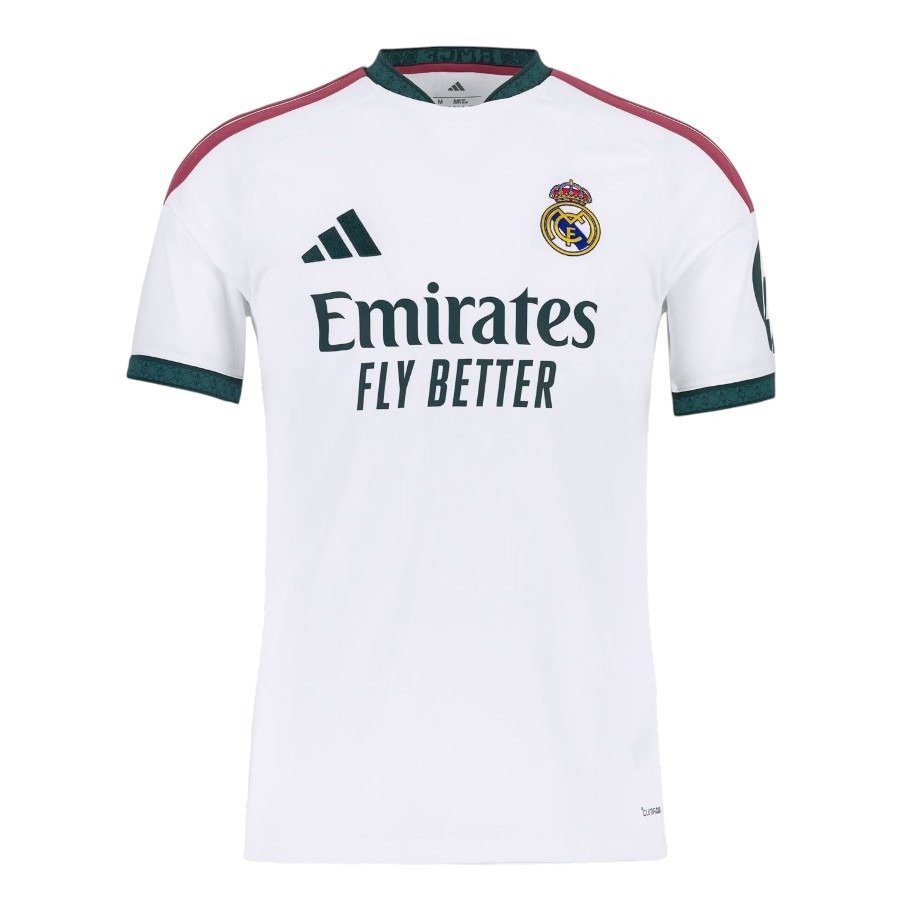
For shirt collectors, Di Stefano’s Real Madrid shirts are among the most desirable of all. The 1950s white shirts were simple: a plain white body, a collar, the club crest on the chest, and no sponsor at all. That simplicity is part of their beauty. Modern Real Madrid home shirts keep the same all-white identity, and the No. 9 remains a famous number at the club. The current home shirt is the closest a modern fan can get to the look Di Stefano wore — the same white, the same crest, the same idea.
If you are building a collection around the great No. 9s, Di Stefano is where it starts. His shirts represent the moment Real Madrid became Real Madrid: the white shirt, the European Cups, and a player who could do everything. Other forwards have scored more goals since, but few have shaped a club — or a position — the way the Blond Arrow did.
Find the latest Real Madrid shirts in the Real Madrid collection (https://elevenkick.com/product-category/la-liga/real-madrid/), including the Real Madrid home shirt (https://elevenkick.com/product/real-madrid-soccer-jersey-home-custom-shirt-2025-26/), and read the story of his great strike partner in our Ferenc Puskas jersey guide (https://elevenkick.com/ferenc-puskas-soccer-jersey-the-no-10-shirts-of-the-galloping-major/). Browse the full range at the ElevenKick shop (https://elevenkick.com/shop/).