In the late 1990s, one striker changed what football thought a centre-forward could be. Ronaldo Nazario — known around the world as O Fenomeno, “The Phenomenon” — combined the power of a target man with the speed and skill of a winger, and he did it in some of the most famous No. 9 shirts in the game. From Barcelona to Inter Milan, from Real Madrid to Brazil, his shirts are among the most collected in football. Here is the story of the No. 9 shirts that made him a legend.
From Cruzeiro to PSV
Ronaldo was born in Rio de Janeiro in 1976 and began his professional career with Cruzeiro in Brazil, where his goalscoring quickly marked him out as a special talent. In 1994, still a teenager, he moved to Europe to join PSV Eindhoven in the Netherlands. It was a smart first step: in two seasons at PSV he scored 54 goals in 58 matches, and the red-and-white striped shirt of the Dutch club became the first European jersey associated with his name.
That same year, 1994, he was taken to the World Cup in the United States as part of Brazil’s squad. He did not play a minute as Brazil won the tournament, but he was there, learning from Romario and Bebeto, and the yellow shirt he wore on the bench that summer was the start of a long love affair with the Brazil No. 9.
The Barcelona season
In the summer of 1996, Ronaldo joined Barcelona, and what followed was one of the great single seasons in football history. Wearing the blue-and-red striped shirt with the No. 9 on his back, he scored 47 goals in 49 matches, won the European Cup Winners’ Cup, and produced a goal against Compostela — a weaving run from inside his own half, beating defender after defender — that is still shown in highlight reels today. The Barcelona shirt of 1996-97, with its classic stripes, is one of the most iconic club shirts of the decade, and it is inseparable from Ronaldo’s name.
He won the Ballon d’Or in 1997, at just 21 years old, and was named FIFA World Player of the Year twice in a row. It seemed like the start of a decade of dominance. Instead, the years that followed would test him in ways no one expected.
Inter Milan and the No. 9
In 1997, Ronaldo moved to Inter Milan in Italy, and the black-and-blue striped shirt of the Nerazzurri became his next home. His first season in Serie A was superb — he won the UEFA Cup in 1998 and was again named the world’s best player. But then came the injuries. A serious knee injury in 1999, followed by another in 2000, kept him out of the game for almost two years. Many people thought his career was over. The Inter shirt he returned in was a symbol of one of football’s great comebacks.
The comeback reached its peak at the 2002 World Cup, where Ronaldo — back in Brazil’s yellow shirt — scored eight goals, won the Golden Boot, and scored both goals in the 2-0 final victory over Germany. It was one of the most emotional moments in World Cup history: a player written off by injury, returning to win the game’s biggest prize. He won the Ballon d’Or for a second time that year.
Real Madrid’s Galacticos
After the 2002 World Cup, Ronaldo joined Real Madrid, becoming part of the famous “Galacticos” team alongside Zinedine Zidane, Luis Figo, Raul and David Beckham. The white shirt of Real Madrid suited him perfectly, and he scored more than 100 goals for the club over four and a half seasons, winning two league titles. The sight of Ronaldo in the all-white shirt, running at defences with that explosive first step, became one of the defining images of 2000s football.
He later had a short spell with AC Milan, wearing the red-and-black striped shirt, before returning to Brazil to finish his career with Corinthians in 2009. He retired in 2011, having scored more than 400 career goals and having won two World Cups, two Copa Americas, two Ballon d’Or awards and three FIFA World Player of the Year titles.
The Brazil shirts
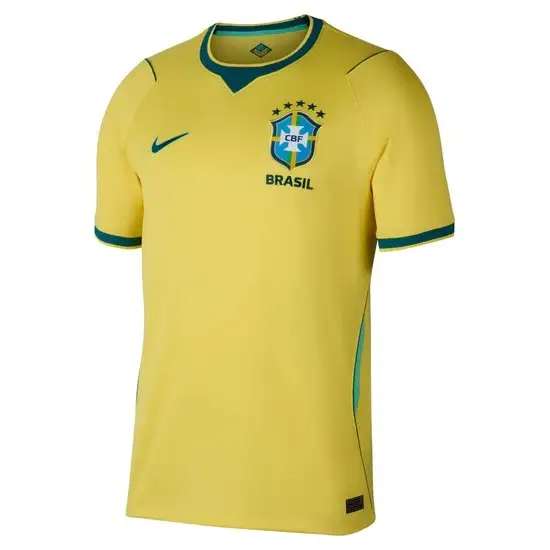
For all his club success, Ronaldo’s greatest legacy is in the yellow shirt of Brazil. He played at four World Cups — 1994, 1998, 2002 and 2006 — and scored 15 World Cup goals in total, a record at the time that stood until Germany’s Miroslav Klose passed it in 2014. The 1998 shirt is remembered for the final defeat to France and the mystery of his illness on the day of the match; the 2002 shirt is remembered for glory; the 2006 shirt for his final World Cup goals, scored in Germany against Japan and Ghana.
Each of those Brazil shirts tells a different chapter of his story, and collectors value all of them. The 2002 version is the most celebrated, but the 1998 shirt — the one from the tournament where he first carried Brazil’s hopes as the main man — has its own special place in football history.
Collecting a Ronaldo shirt
If you are looking for a Ronaldo shirt, start with the Brazil yellow — it is the shirt most associated with him, and the one that represents his greatest achievements. You can see the current Brazil design on the Brazil 2026 World Cup Jersey. Then consider the Barcelona 1996-97 shirt, the Inter shirt, or the Real Madrid white: each one represents a different era of his career, and each one is a classic design in its own right. Check the size guide before ordering, and remember that a good shirt should fit comfortably whether you wear it to a match or frame it on the wall.
Ronaldo Nazario’s No. 9 shirts are more than collectibles. They are the jerseys of a player who changed the position he played, who came back from injuries that would have ended most careers, and who won the World Cup in one of the great comebacks in sport. You can explore our Brazil shirts and club collection at the ElevenKick shop.