There has never been a left-back quite like Roberto Carlos. For eleven seasons at Real Madrid he wore the number 3 shirt, and he turned a defensive position into an attacking weapon — overlapping runs, thunderous shots, and free kicks that seemed to bend the laws of physics. He won three Champions Leagues with Madrid, the 2002 World Cup with Brazil, and a place in football history as one of the greatest full-backs of all time. This is the story of the shirts he wore.
From Garça to the world
Roberto Carlos da Silva was born on 10 April 1973 in Garça, in the state of São Paulo, Brazil. He started his career at Uniao Sao Joao, a small club in the Sao Paulo countryside, before joining Palmeiras in 1993. At Palmeiras he won the Brazilian league twice and earned his first call-up to the national team, and his powerful left foot was already making headlines. In 1995 he moved to Europe, joining Inter Milan in Italy for a single season before Real Madrid came calling in the summer of 1996.
The move to Madrid changed his life. He was 23 years old, and he would spend the next eleven seasons at the Santiago Bernabeu, making more than 500 appearances in all competitions and becoming one of the most loved players in the club’s history. The number 3 shirt he wore became as famous as the player himself.
The number 3 at Real Madrid
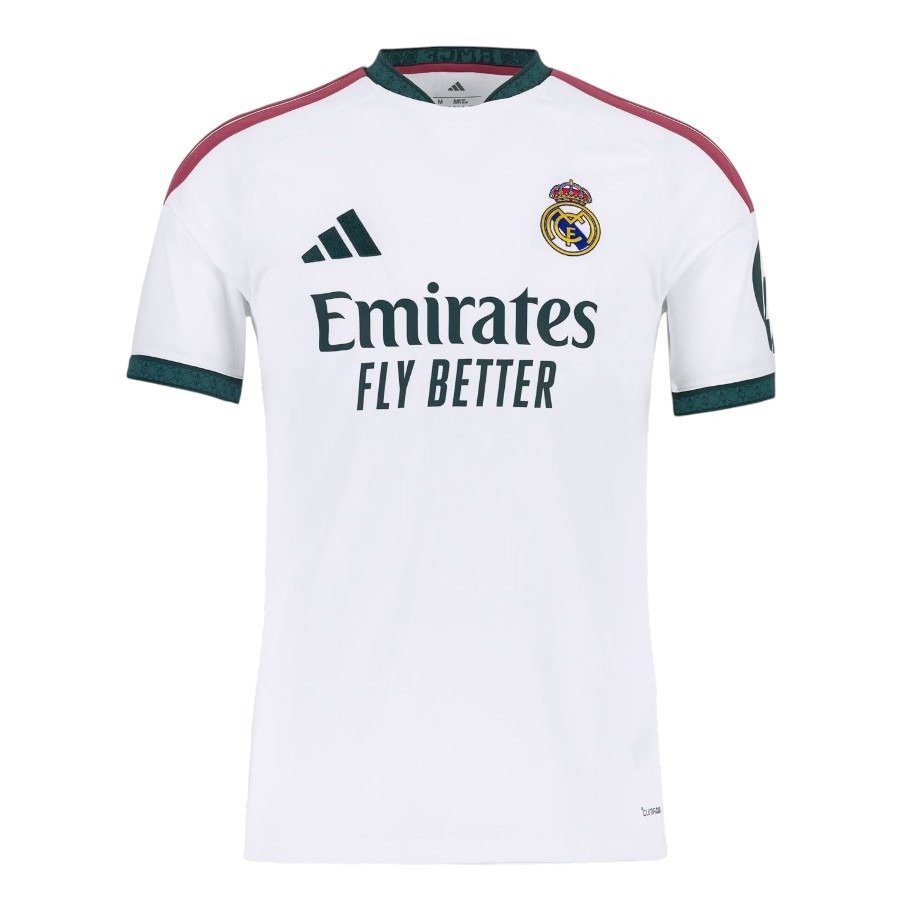
At Real Madrid, Roberto Carlos wore the number 3 shirt, and he made it his own. The white shirt of Madrid is one of the most famous in football, and the number 3 on the back became a symbol of attacking football from defence. Roberto Carlos did not stay in his own half. He charged forward on the left wing, linked up with the forwards, and scored goals that no full-back had any right to score.
His honours at Madrid tell the story of a golden era. He won La Liga four times, in 1997, 2001, 2003 and 2007, and he won the Champions League three times, in 1998, 2000 and 2002. The 1998 win ended a 32-year wait for the European Cup, the 2000 win came in Paris against Valencia, and the 2002 win in Glasgow featured Zinedine Zidane’s famous volley in the final against Bayer Leverkusen. Roberto Carlos played his part in all three, and he also won the Intercontinental Cup twice and the Spanish Super Cup three times.
He was part of the Galacticos era too, playing alongside Zidane, Raul, Luis Figo, Ronaldo and David Beckham. You can read about his great teammate and captain in our Raul Gonzalez jersey guide (https://elevenkick.com/raul-gonzalez-soccer-jersey-the-no-7-shirts-of-a-real-madrid-legend/). While the stars took the headlines, Roberto Carlos did the running — up and down the left side, for ninety minutes, for eleven seasons.
The free kick that bent physics
Roberto Carlos’s most famous moment came not for Real Madrid but for Brazil, on 3 June 1997, in a friendly tournament in France. Brazil were playing the hosts at the Stade de Gerland in Lyon, and they won a free kick about 35 metres from goal. Roberto Carlos stepped up, took a long run-up, and struck the ball with the outside of his left foot. The ball flew wide of the wall, seemed to be heading for the advertising boards, and then bent back through the air and into the net past a helpless Fabien Barthez.
The free kick is still studied by physicists and replayed by football fans today, because the bend on the ball looked impossible. It was the perfect summary of Roberto Carlos as a player: power, technique, and a willingness to try something nobody else would dare. He scored many free kicks in his career, but that one in Lyon is the one every football fan remembers.
Number 6 for Brazil, number 3 for Madrid
One detail collectors should know: Roberto Carlos wore different numbers for club and country. At Real Madrid he was number 3, but for Brazil he wore number 6. The Brazil number 6 shirt is the one he wore at the 2002 World Cup in Korea and Japan, where Brazil won their fifth title. He played every game of that tournament, and he scored a trademark free kick against China in the group stage, bending the ball around the wall from distance.
His Brazil career was long and decorated. He won 125 caps and scored 11 goals for his country, won the Copa America in 1997 and 1999, the Confederations Cup in 1997, and reached the World Cup final in 1998 before winning the trophy in 2002. He played in three World Cups in total — 1998, 2002 and 2006 — and his attacking runs down the left were a feature of every Brazil team he played in. The yellow Brazil shirt with number 6 on the back is one of the most recognisable international shirts of the modern era.
The later years and the legacy
Roberto Carlos left Real Madrid in 2007 and joined Fenerbahce in Turkey, where he spent two seasons and became a hero with the supporters in Istanbul. He then returned to Brazil with Corinthians in 2010, and finished his playing career with Anzhi Makhachkala in Russia in 2012. He later worked as a coach in Turkey and India, but his playing legacy was already secure.
That legacy is simple: he changed what a full-back could be. Before Roberto Carlos, full-backs were defenders who occasionally crossed the halfway line. After him, every team wanted a left-back who could attack like a winger, shoot like a striker, and take free kicks like a playmaker. Cafu did the same on the right for Brazil, and together they formed the most attacking full-back pairing the game has ever seen.
Choosing a Roberto Carlos shirt for your collection
If you are adding a Roberto Carlos shirt to your collection, you have two classic choices. The Real Madrid white shirt with number 3 is the shirt of his club career — eleven seasons, three European Cups, and the Galacticos era. The Brazil yellow shirt with number 6 is the shirt of his international career — the 2002 World Cup, the Copa America titles, and the free kick in Lyon. Both are prized by collectors, and both look superb on display.
Check the details carefully when you buy. The Real Madrid shirt should be the classic white with the club crest on the chest, and the Brazil shirt the famous yellow with green trim. The number and name should be clean and sharp, and the shirt should feel light and breathable. A Roberto Carlos shirt is not just a piece of football history — it is a reminder of a player who made the impossible look routine.
Why the Roberto Carlos shirt belongs in a collection
Every great shirt collection needs a number 3, and Roberto Carlos is the reason why. His shirts represent a player who redefined his position, a free kick that defied physics, and an era when Real Madrid and Brazil played the most exciting football on the planet. The white Madrid shirt and the yellow Brazil shirt are two of the most famous shirts in the game, and Roberto Carlos wore them both with distinction.
If you want a shirt that stands for power, adventure and pure joy, the Roberto Carlos shirt is a strong choice. You can browse the current Real Madrid shirts in the Real Madrid collection (https://elevenkick.com/product-category/la-liga/real-madrid/), see the latest Brazil shirt in the Brazil 2026 World Cup jersey (https://elevenkick.com/product/brazil-2026-world-cup-jersey/), and the full range is waiting in the ElevenKick shop (https://elevenkick.com/shop/).