
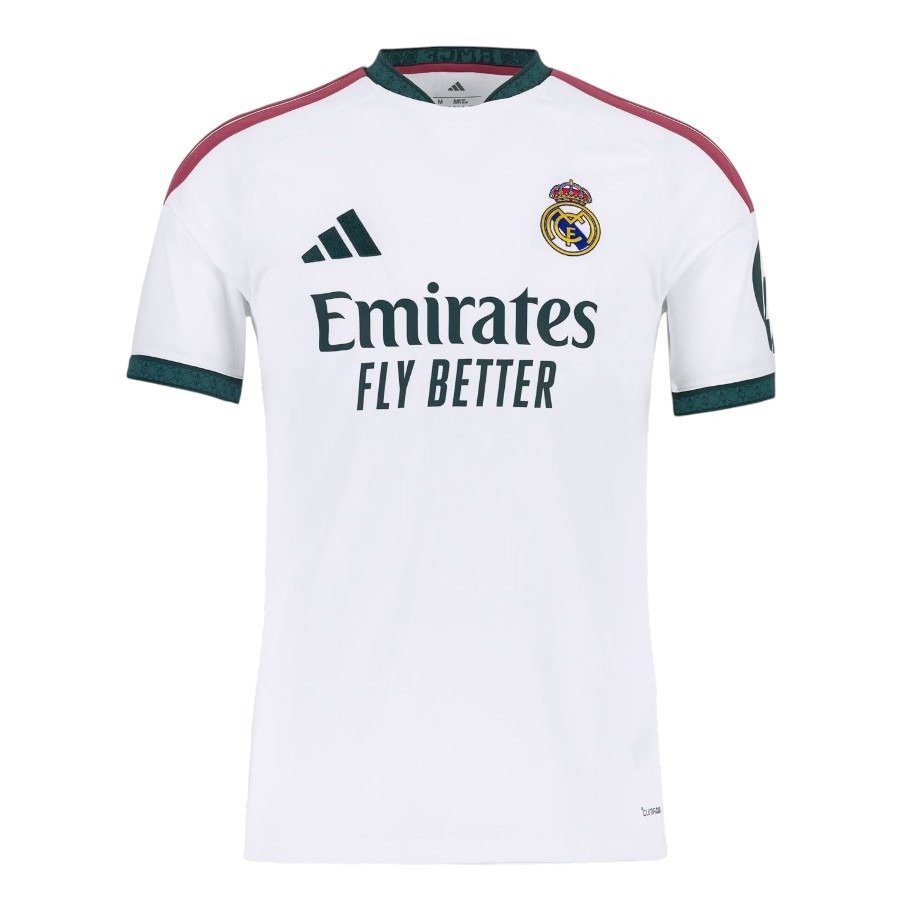
There are players who wear a shirt, and there are players who become the shirt. Raul Gonzalez was the second kind. For sixteen seasons, from 1994 to 2010, the No. 7 shirt of Real Madrid belonged to a boy from Madrid who had joined the club’s youth academy after Atletico Madrid closed theirs. He made a record 741 appearances, scored 323 goals, won three European Cups and six league titles, and when he left in 2010 he was the club’s all-time leading goalscorer. The white shirt of Real Madrid has been worn by many great players, but for a generation of supporters, the No. 7 was Raul.
The boy from Madrid who became No. 7
Raul was born in Madrid in 1977, and he grew up supporting Atletico Madrid, where he played in the youth teams. In 1992, Atletico closed their youth academy, and Raul joined Real Madrid’s youth setup instead. It was a twist of fate that changed his life and the history of both clubs. Two years later, at the age of 17, he was promoted to the first team by the manager Jorge Valdano, who had been impressed by the young striker’s movement, intelligence and finishing.
Raul was not the fastest player, and he was not the strongest. What he had was an instinct for where the ball would be, and a calmness in front of goal that players twice his age would envy. He read the game like a veteran, and he scored goals that looked simple because he had made them simple. The No. 7 shirt became his, and he wore it for almost his entire Madrid career.
A debut at 17 and a goal against Atletico
Raul made his first-team debut on 29 October 1994, against Real Zaragoza, at the age of 17. A week later, he scored his first goal for the club — against Atletico Madrid, the club he had grown up supporting. It was a sign of things to come: Raul scored goals that mattered, in games that mattered, from the very start.
In his first season, he helped Real Madrid win the league title, scoring nine goals in 28 games as a teenager. By the following season, he was a regular in the side, and by the late 1990s he was one of the best strikers in Europe. The white shirt suited him, and the Bernabeu took him to its heart. He was one of their own, a Madrid boy who had come through the academy and become the face of the team.
Three European Cups and six league titles
Raul’s trophy list is one of the finest in the history of the game. He won the Spanish league title six times: in 1995, 1997, 2001, 2003, 2007 and 2008. He won the Champions League three times: in 1998, 2000 and 2002. He won the Intercontinental Cup twice, in 1998 and 2002, and the UEFA Super Cup once, in 2002. He also won the Spanish Super Cup four times.
The 1998 Champions League win was the most important. Real Madrid had not won the European Cup for 32 years, and the final against Juventus in Amsterdam was won 1–0, with Predrag Mijatovic scoring the only goal. Raul was 20 years old, and he had helped end a wait that had lasted longer than he had been alive. Two years later, Madrid won it again, beating Valencia 3–0 in Paris. And in 2002, they won it a third time, beating Bayer Leverkusen 2–1 in Glasgow, in the final remembered for Zinedine Zidane’s famous volley.
Goals in Champions League finals
Raul scored in two Champions League finals, and that is a measure of the player he was. In the 2000 final against Valencia, he scored the third goal, rounding the goalkeeper Santiago Canizares and finishing calmly to seal a 3–0 win. In the 2002 final against Bayer Leverkusen, he scored the opening goal, finishing from Roberto Carlos’s cross to give Madrid the lead.
He finished his European career with 71 Champions League goals, and at the time he left Real Madrid he was the competition’s all-time leading scorer. Only Cristiano Ronaldo and Lionel Messi have since passed him. It is a record that tells you everything about Raul: he scored goals at the highest level, in the biggest games, for more than a decade.
Spain: 102 caps and the trophy that never came
For all his success with Real Madrid, Raul never won a major trophy with Spain. He made his debut for the national team in 1996, and he went on to win 102 caps and score 44 goals, captaining the side for many years. He played at three World Cups, in 1998, 2002 and 2006, and at two European Championships, in 2000 and 2004. He scored at every major tournament he played in, and he was Spain’s record goalscorer for many years.
But the trophies never came. Spain were knocked out in the group stage in 1998, lost on penalties to South Korea in the quarter-finals in 2002, and were beaten by France in the last 16 in 2006. Raul retired from international football in 2006, at the age of 29, and two years later Spain won Euro 2008, the first of three straight major trophies. It is one of the great what-ifs of Spanish football: the country’s greatest striker of his generation never played in a team that won a trophy. The red shirt of Spain was the one shirt that did not bring him luck, and it is the one gap in a remarkable career.
The ring-kiss celebration
Every great player has a signature, and Raul’s was his celebration. After scoring, he would kiss the ring on his left hand — his wedding ring, a tribute to his wife, Mamen Sanz, whom he married in 1999. It was a quiet, private gesture in a sport full of loud ones, and it told you something about the man. Raul was not a showman. He did not dance, he did not take his shirt off, he did not seek the cameras. He kissed his ring, and he ran back to the halfway line.
The celebration became as famous as the player. Supporters copied it, children copied it, and it became one of the most recognisable goal celebrations in football. It was simple, it was sincere, and it was Raul.
Schalke, Qatar, New York — and the road back to Madrid
Raul left Real Madrid in the summer of 2010, after sixteen seasons, to join Schalke 04 in Germany. He was 33, and many expected him to fade. Instead, he scored 40 goals in two seasons, won the German Cup in 2011, and helped Schalke reach the semi-finals of the Champions League. He was loved in Gelsenkirchen, and the Schalke shirt became another chapter in his story.
From Schalke he moved to Al Sadd in Qatar, where he won the league title, and then to the New York Cosmos, where he ended his playing career in 2015. But Madrid was always home, and in 2019 he returned to the club as the head coach of Real Madrid Castilla, the reserve team. The boy who had joined the academy in 1992 was now coaching the next generation of Madrid players, in the same white shirt.
Which Raul shirt to choose
If you are looking for a Raul shirt, the No. 7 white shirt of Real Madrid is the one to find. It is the shirt he wore for sixteen seasons, the shirt he wore in three Champions League finals, and the shirt he wore when he became the club’s record appearance holder. Look for a clean white shirt, with the No. 7 on the back and the name Raul above it, and you will have one of the great shirts of modern football.
The white shirt of Real Madrid has been worn by many legends, but for a generation, it was Raul’s. Browse the Real Madrid collection in the ElevenKick shop and find the white shirt that fits your collection.

