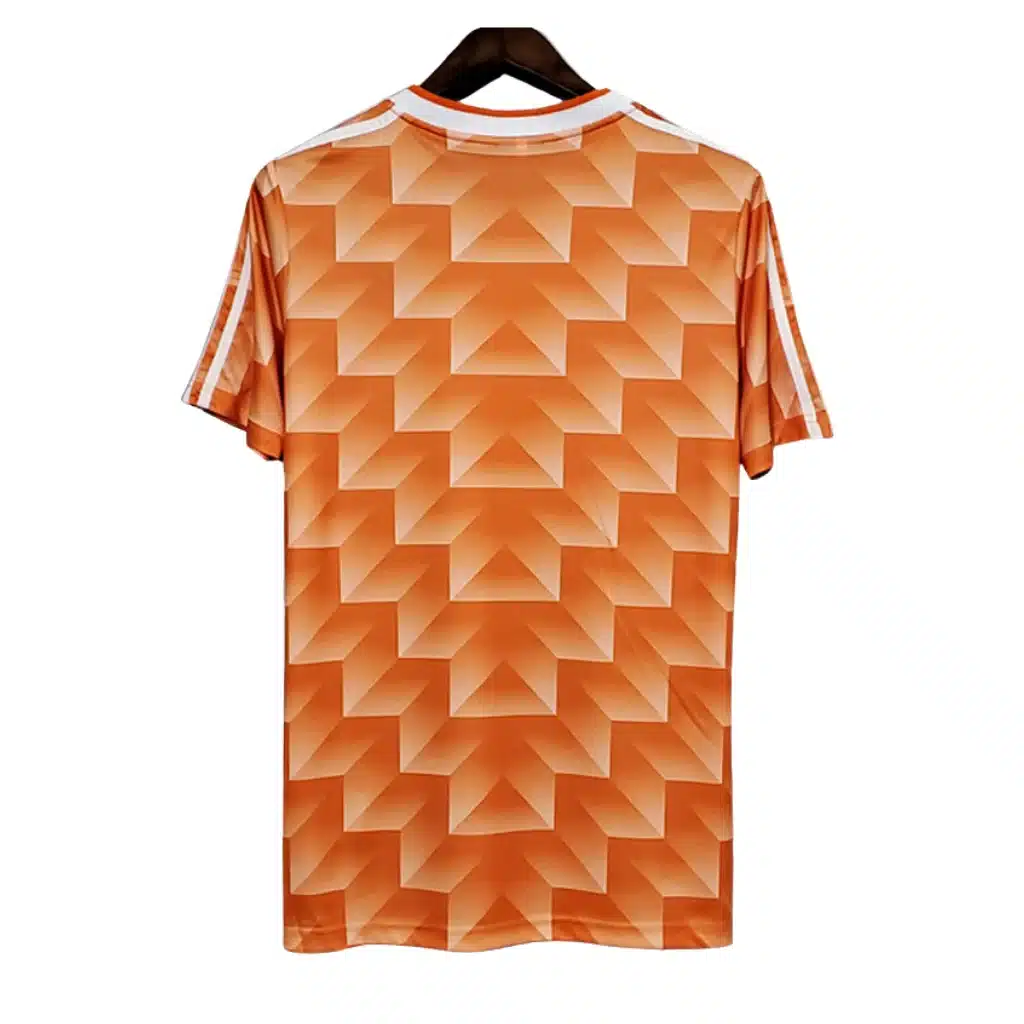
Some football shirts are remembered because of the team that wore them, and some are remembered because of the design itself. The Netherlands shirt from Euro 1988 manages both. It is the shirt of the only major trophy the Dutch have ever won, and it is also one of the most distinctive designs in the history of the game: bright orange, covered in a white geometric pattern, worn by a team that played football like no other. More than thirty-five years later, it is still the first shirt most fans picture when they think of the Netherlands.
The summer the Netherlands finally won something
By 1988, the Netherlands had a reputation as the great nearly-men of international football. The team of Johan Cruyff had reached two World Cup finals, in 1974 and 1978, and lost them both. The football the Dutch played was admired everywhere, but the trophy cabinet was empty. Euro 1988, held in West Germany, changed that.
The Dutch side was built around three great players: Ruud Gullit, the captain, a powerful midfielder and forward who wore the number ten; Marco van Basten, one of the finest strikers of his generation; and Frank Rijkaard, the calm and commanding midfielder at the heart of the team. Behind them stood Ronald Koeman, whose passing set the tempo, and in charge was Rinus Michels, the coach who had invented the Total Football style of the 1970s and returned to lead his country to the title.
The Netherlands lost their opening group game 1-0 to the Soviet Union, and for a moment it looked like another Dutch disappointment. Then the team found its rhythm: a 3-1 win over England, with Van Basten scoring all three goals, and a 1-0 win over the Republic of Ireland sent them into the semi-finals. There they met the hosts, West Germany, in Hamburg, and won 2-1, with goals from Koeman and Van Basten. It was the first Dutch win over West Germany in a major tournament, and it is still one of the most celebrated results in the country’s history.
The final, in Munich on 25 June 1988, was a rematch against the Soviet Union. Gullit opened the scoring with a header, and then Van Basten scored one of the most famous goals ever seen at a major tournament: a volley from an almost impossible angle on the right side of the penalty area, struck first time over the goalkeeper and into the far corner. The Netherlands won 2-0, and for the first time, the Dutch were champions of Europe.
A shirt like no other
The shirt the Dutch wore that summer was as bold as the football they played. It was bright orange, the colour of the Dutch royal house and the national team’s identity since the beginning. Across the front ran a white geometric pattern of triangles and blocks, a design that looked modern and unmistakably Dutch. The sleeves and collar carried simple white and black trim, and the crest sat over the heart.
It was a shirt made for television. In an era when most national team shirts were plain and simple, the Dutch shirt stood out in every photograph and every highlight reel. That is part of why it has lasted in the memory: the goals were spectacular, and the shirt was spectacular too. When fans picture Van Basten’s volley, they picture it in orange and white.
The design has been copied and referenced many times since, and it remains one of the most sought-after retro shirts in football. For collectors, the 1988 shirt is the essential Netherlands shirt, the one that marks the country’s greatest triumph and the peak of a golden generation.
The players who made it famous
The 1988 team is remembered as a team, but the shirt is tied to its stars. Gullit wore it as captain, his dreadlocks and his powerful running making him one of the most recognisable players in the world. Van Basten wore it as the tournament’s top scorer, with five goals including the hat-trick against England and the volley in the final. Rijkaard wore it as the anchor of the midfield, and Koeman wore it as the man who started the attacks from the back.
That generation went on to further success at club level, with Gullit, Van Basten and Rijkaard forming the famous Dutch trio at AC Milan, but Euro 1988 remains their shared peak with the national team. It was the one summer when Dutch football had everything: the style, the players, the goals, and the trophy.
Why collectors love the 1988 shirt
Retro shirts are judged by three things: the design, the tournament, and the players. The Netherlands 1988 shirt scores on all three. The geometric pattern is one of the most recognisable designs ever worn at a European Championship. The tournament ended with the country’s only major trophy. And the players who wore it are among the greatest the game has produced.
For fans building a retro collection, the 1988 shirt is a natural centrepiece. It pairs well with other tournament classics, and it is a shirt that starts conversations: everyone who follows football has an opinion about that design, and most of them have seen Van Basten’s goal. It is also a shirt that wears well today. The orange is bright without being loud, and the pattern gives it a character that plain retro shirts do not have.
The retro jersey today
The Netherlands 1988 Retro Jersey at ElevenKick recreates that famous design in a premium-quality, vintage-style shirt, with a comfortable fit that runs true to size. It is available in sizes from small to XXXL, and it is made for supporters and collectors who love the 1988 era. Whether you wear it to a match, on a night out, or keep it as part of a collection, it is a shirt with a story that needs no explanation.
The Netherlands have had many fine teams and many fine shirts since 1988, but none of them has matched that summer. The orange shirt of Euro 1988 is the shirt of the Flying Dutchmen at their finest, and it is still flying. Browse the Netherlands 1988 Retro Jersey at ElevenKick and own a piece of football history.