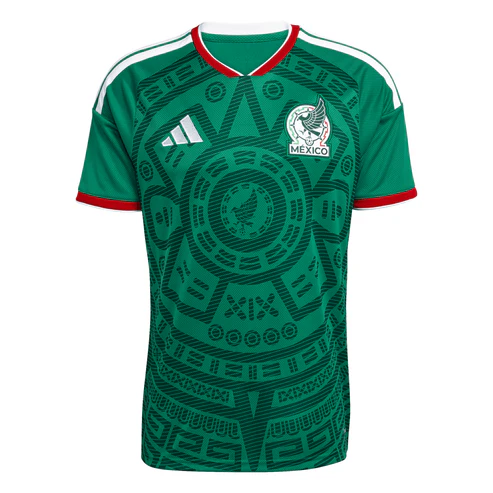
Why do Mexico wear green? The short answer is that green is the colour most closely linked to the national team, to the national flag, and to the shirt that fans reach for first on match day. When Mexico walk out in their home kit, the green shirt does most of the talking before a ball is kicked. It is bright, it is unmistakable, and it carries decades of World Cup memories, famous goals, and packed stadiums with it. This guide looks at where that green shirt comes from, how it has been worn through different eras, and how to choose one that suits you as a supporter.
Why Mexico Wear Green
Mexico’s home shirt is green because green sits at the heart of the country’s sporting identity. It is one of the three colours of the Mexican flag, alongside white and red, and those three colours have shaped the national team’s kits for generations. The home shirt is usually green, the away shirt is usually white, and red often appears as a trim or as an accent. That simple system makes Mexico easy to recognise on television, in a stadium crowd, and in a photograph from almost any era. Fans do not need a badge or a name on the back to know which team is playing. The green alone tells the story, and that is why the home shirt remains the most popular choice for supporters, even when away and third designs change from tournament to tournament.
The Green Home Shirt and Its Red and White Trim
A Mexico home shirt is at its best when the green is bold and the trim is kept simple. Red and white details around the collar, the cuffs, and the chest give the shirt its national-team character without taking attention away from the main colour. In some years the trim has been a thin line, in others a broader band, and in others a pattern inspired by traditional Mexican design. The effect is usually the same: a shirt that looks proud, warm, and full of energy. For collectors, those small changes matter, because they help to place a shirt in a particular tournament or era. For everyday fans, the most important thing is simpler. Choose a shade of green you enjoy wearing, check that the trim sits neatly, and make sure the shirt feels comfortable when you move, sit, and celebrate.
Estadio Azteca and Home Identity
No discussion of the Mexico shirt is complete without Estadio Azteca in Mexico City. The stadium has hosted some of the most famous matches in World Cup history, and it is a place where the green shirt feels most at home. When the stadium is full, the crowd becomes a sea of green, with flags, scarves, and shirts all working together. That atmosphere is part of why the shirt matters so much. It is not only a piece of clothing. It is a way of belonging to a crowd, of showing loyalty to El Tri, and of taking part in a shared occasion. Even for fans watching from home, putting on the green shirt changes the feeling of a match. It turns a normal evening into an event, and it connects a supporter in one city to supporters in many others.
Mexico as Host in 1970 and 1986, and Co-Host in 2026
Mexico has a rare place in World Cup history as a host nation. The country hosted the tournament in 1970 and again in 1986, and it is set to co-host the 2026 tournament alongside the United States and Canada. That history gives the green shirt an extra layer of meaning. In 1970 and 1986, the world came to Mexico, and the home shirt was seen by a global audience in stadiums across the country. Looking ahead to 2026, the preview is about excitement, travel, and a new generation of fans discovering the team, rather than about results that have not happened yet. No outcome can be claimed in advance, and no score can be predicted with certainty. What can be said is that a home tournament brings the shirt back into focus, and that many fans will want a Mexico shirt to wear while they follow the build-up and the matches themselves.
The Hugo Sanchez Era
For many older fans, the green shirt is linked first to Hugo Sanchez. Sanchez was one of Mexico’s most gifted forwards, known for his movement, his finishing, and his spectacular goals. He became a star in Mexico before enjoying a celebrated club career in Spain, and he remained a central figure for the national team through the 1980s. Wearing the green shirt in that era meant representing a team that was growing in confidence and ambition on the world stage. Sanchez gave supporters a player to admire and a reason to believe that Mexico could compete with the best teams in the world. Even today, when fans talk about classic Mexico shirts, they often talk about the shirts worn during his years with the national team, because those shirts are tied to memories of flair, confidence, and goals.
The Marquez and Chicharito Generation
A later generation brought the green shirt to a new audience. Rafael Marquez, a calm and commanding defender and midfielder, became one of the most respected Mexican players of his time, appearing at multiple World Cups and leading by example on the pitch. Around the same period, Javier Hernandez, known to fans as Chicharito, became one of Mexico’s most recognisable forwards, famous for his movement in the box and his instinct for scoring important goals. Together, they represented a team that was organised, hard-working, and capable of memorable performances against strong opposition. For supporters who grew up in the 2000s and 2010s, the green shirts from those years are the shirts of their own football memories. They are the shirts worn while watching with family, while travelling to matches, and while following Mexico through tournament after tournament.
What the Green Shirt Means to Fans
For Mexican fans, and for fans of Mexican football around the world, the green shirt is about identity as much as it is about sport. It is worn at family gatherings, at watch parties, at stadiums, and on the street on match days. It is passed between generations, with parents and children often wearing the same colours. It also travels well. Mexico supporters are known for following the team in large numbers, and the green shirt makes that support visible wherever the team plays. That visibility matters. It creates a sense of community among strangers, it starts conversations, and it turns a single shirt into a shared symbol. Whether a fan has followed El Tri for decades or has only recently discovered the team, the green shirt offers an easy and welcoming way in.
Choosing a Mexico Shirt: Fit, Feel and Care
Choosing a Mexico shirt should start with fit. Look for a fan-inspired, premium-quality shirt with a replica fit that matches how you like to wear your kits. If you prefer a relaxed fit, choose a size that gives you room around the chest and shoulders. If you prefer a closer fit, size down only if the fabric still allows you to move freely. Check the length as well, because a shirt that is too short can ride up, while a shirt that is too long can look untidy when tucked in or worn casually. For care, wash the shirt in cold water, turn it inside out, and let it air dry away from direct heat. Avoid harsh detergents and tumble drying, because heat and friction can fade the green and damage printed details over time. With simple care, a Mexico shirt can stay bright and comfortable for many seasons. You can browse the Mexico 2026 World Cup Jersey and the wider Mexico jerseys range, or explore the full shop for national team kits. Whichever green shirt you choose, wear it with pride, and enjoy every match in the colours of El Tri.