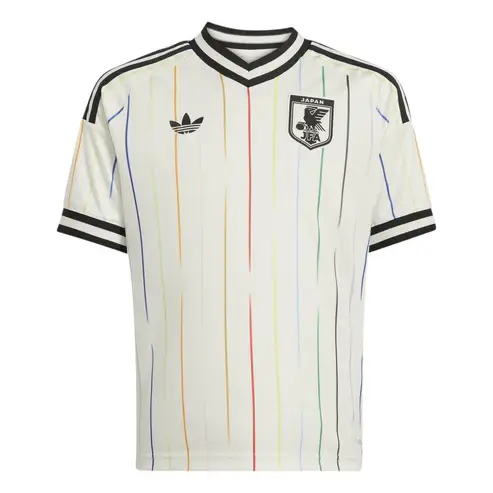
Japan’s national team wears blue, and the shirt has one of the best nicknames in football: Samurai Blue. It is a modern classic, worn by a team that has grown from World Cup newcomers into regulars on the world stage. This is the story of the Japan shirt, how blue became its identity, and why it has become a favourite with collectors far beyond Japan.
Why blue?
Blue is an unusual choice for Japan, whose flag is red and white. The blue shirt became the team’s identity in the 1990s, as Japanese football professionalised and the J.League launched. The colour is said to represent the blue of the sky and the sea around Japan, and it gave the national team a distinct look that stood out on television. The crest of the Japan Football Association features the Yatagarasu, a three-legged crow from Japanese mythology, which adds a layer of national symbolism to the shirt. Over time, supporters embraced the colour completely, and “Samurai Blue” became the team’s identity.
The first World Cup: France 1998
Japan qualified for the World Cup for the first time at France 1998. The team did not win a match at that tournament, but simply being there was a milestone for a country where baseball had long been the biggest sport. The blue shirt from that era marks the beginning of Japan’s World Cup story, and retro versions of the late-1990s designs are now popular with collectors who remember the team’s first steps on the world stage.
Co-hosts of the 2002 World Cup
Four years later, Japan co-hosted the 2002 World Cup with South Korea, and the tournament changed football in Japan forever. The national team reached the round of 16 on home soil, playing in front of huge, passionate crowds. The blue shirt became a symbol of national pride during that summer, seen everywhere from stadiums to city streets. For a generation of Japanese fans, the 2002 shirt is the one they remember first, because it belongs to the tournament that brought the World Cup to their country.
The modern era: 2010, 2018 and 2022
Japan has now qualified for every World Cup since 1998, and the modern teams have produced famous moments in the blue shirt. At South Africa 2010 and Russia 2018, Japan reached the knockout rounds, and at Qatar 2022 the team produced two of the great shocks of the tournament by beating Germany and Spain in the group stage before losing to Croatia on penalties in the round of 16. Each of those campaigns added to the shirt’s reputation, because Japan became known as a team that plays brave, technical football and never gives up.
The design language of the Japan shirt
Japan’s shirts are known for thoughtful design. Recent editions have drawn on Japanese culture, including patterns inspired by origami, the traditional art of paper folding, and clean, detailed graphics that reward a closer look. The home shirt stays blue, but the shade and the pattern change from tournament to tournament, which makes each edition distinct. Away shirts have often used white or red, giving collectors several strong options from each cycle. The result is a national-team shirt range that feels designed, not just manufactured.
What the shirt means to fans
For Japanese supporters, the blue shirt represents a football culture built from scratch in a few decades. Fans wear it with pride at tournaments around the world, and it has become a common sight in stadiums far from Japan. For international collectors, the Japan shirt is attractive because it combines a strong colour, intelligent design and a team with a clear identity. It is one of the few national-team shirts that looks equally good in a collection and on the street.
Looking ahead to the 2026 World Cup
Japan were among the earliest teams to book their place at the 2026 World Cup, which will be hosted by the United States, Canada and Mexico. Supporters will be watching for the new tournament shirt, and the blue shirt will once again be one of the most watched designs of the summer. Whatever the new edition looks like, it will carry the same identity that has been built since the 1990s: blue, bold and unmistakably Japanese.
How to wear the Samurai Blue shirt
The Samurai Blue shirt is one of the easiest national-team shirts to wear beyond matchdays, because its deep blue works with almost anything. Pair it with dark jeans or simple shorts for a clean weekend look, and let the blue do the talking rather than adding bright colours on top. When choosing a size, check the size guide first, because a fan-inspired, premium-quality shirt with a replica fit can sit closer to the body than a loose training top, and many supporters prefer one size up for comfort. Care for it the same way you would any favourite shirt: wash it cold and inside out, skip the tumble dryer, and hang it to dry so the colour and any fine pattern stay sharp. Worn well, the Japan shirt moves easily from a watch party to a casual day out, and it always sparks a conversation about one of world football’s most admired teams.
If you want to add the Samurai Blue shirt to your collection, you can find the Japan 2026 World Cup jersey in the ElevenKick shop. Browse the Japan jersey and the full shop here: Japan 2026 World Cup jersey and the ElevenKick shop.