
Gerd Muller was not tall, not fast, and not elegant. He was short, stocky, and awkward-looking — and he was the greatest goalscorer football has ever seen. In fifteen years at Bayern Munich and with West Germany, he scored goals at a rate no one has matched: 68 goals in 62 games for his country, 365 Bundesliga goals, and the winning goal in a World Cup final. They called him Der Bomber — the Bomber — because the ball kept exploding into the net whenever he was near it. This is the story of the No. 9 shirts of Gerd Muller.
From Nördlingen to Bayern Munich
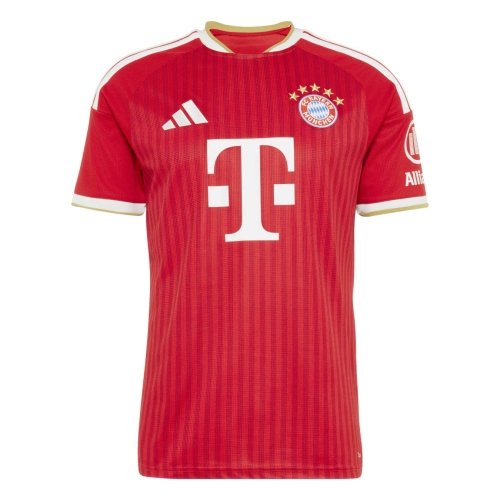
Gerd Muller was born in 1945 in Nördlingen, a small town in Bavaria, and he joined Bayern Munich in 1964, when the club was still in the second division. The coaches were not sure about him at first. He was short and heavy, and he did not look like a footballer. But he scored, and he kept scoring, and within a few years he was the most feared striker in Germany. He stayed at Bayern for fifteen seasons, from 1964 to 1979, and in that time he scored 453 goals in 580 competitive matches for the club. In the Bundesliga alone he scored 365 goals in 427 games, a record that stood for more than forty years until Robert Lewandowski finally passed it in 2021. The No. 9 shirt he wore at Bayern — the red shirt of the club, still worn today in the current Bayern home shirt — became the shirt of the most reliable goalscorer the game has known.
The 1970 World Cup: ten goals in six games
Muller’s first World Cup, in Mexico in 1970, was the tournament that made him a world star. He scored ten goals in six games, including hat-tricks against Bulgaria and Peru, and he won the Golden Boot as the tournament’s top scorer. West Germany reached the semi-final, where they lost 4-3 to Italy in extra time in one of the greatest matches ever played — the so-called Game of the Century — and Muller scored twice in that match. He finished the tournament with ten goals, and he had announced himself as a striker unlike any other. For West Germany he often wore the No. 13 shirt rather than the No. 9, but the shirt number did not matter. Wherever Muller stood in the penalty area, the ball found him, and the net bulged.
European champion in 1972
Two years later, Muller helped West Germany win the European Championship in Belgium in 1972. The team of that era — with Franz Beckenbauer, Günter Netzer, and Sepp Maier — is remembered as one of the greatest national sides of all time, and Muller was its cutting edge. He scored both goals in the 3-0 final victory over the Soviet Union in Brussels, and he finished the tournament as its top scorer. It was the first European Championship won by West Germany, and it confirmed Muller as the best striker in the world. The white shirt of West Germany, with Muller in it, was the shirt of the champions of Europe.
The winning goal: the 1974 World Cup final
The greatest moment of Muller’s career came on home soil, in the 1974 World Cup final in Munich. West Germany faced the Netherlands, the team of Total Football, and fell behind to a Johan Neeskens penalty after just two minutes — before a German player had even touched the ball. Paul Breitner equalised from the penalty spot, and then, two minutes before half-time, Muller did what he always did. A cross came in from the right, he turned his marker with a short, sharp movement, and he hooked the ball into the corner of the net. It was not a spectacular goal. It was a Muller’s goal: short, close, and unstoppable. West Germany won 2-1, and Muller had scored the goal that won the World Cup. He retired from international football immediately afterwards, at the age of 28, with 68 goals in 62 games — a record of more than a goal a game that has never been matched by any great international striker since.
Three European Cups with Bayern
Muller’s club career was just as decorated. With Bayern Munich he won the European Cup three years in a row — in 1974, 1975, and 1976 — the first club side to achieve the feat in the modern era. He scored in the 1974 final replay against Atlético Madrid, hitting two goals in a 4-0 win, and he was the tournament’s top scorer in three separate seasons. He also won four Bundesliga titles and four German Cups with Bayern, and he won the Ballon d’Or in 1970, the year of his ten-goal World Cup. By the time he left Bayern in 1979, he had scored more goals for the club than any player before or since, and the No. 9 shirt he wore had become a symbol of goals themselves.
The record that stood for 32 years
Muller’s fourteen World Cup goals were a record that stood for thirty-two years. He scored ten in 1970 and four in 1974, and no one passed him until the Brazilian Ronaldo scored his fifteenth at the 2006 World Cup. It is a measure of how extraordinary Muller was that his record survived Pele, Maradona, and every great striker of the next three decades. His Bundesliga record of 365 goals survived even longer, until 2021. And his international record — 68 goals in 62 games — has never been beaten by a German player, and it never will be in the modern game, where a goal a game over a whole international career is almost unthinkable. Muller died in 2021, and the tributes that followed called him the greatest goalscorer of all time. It was not an exaggeration. It was the record speaking.
Which Muller shirt should you choose?
For collectors, the Muller shirt is really two shirts: the red No. 9 of Bayern Munich and the white shirt of West Germany. The Bayern shirt is the easier one to find, and the modern Bayern Munich home shirt carries the same red that Muller wore. The West Germany shirt is best found through the retro range — the Germany 1990 retro jersey is from the generation that followed Muller, but it carries the same white shirt tradition he played in. Whichever you choose, you are choosing the shirt of a player who scored more goals, more reliably, than anyone else who ever played the game. You can start in the ElevenKick shop, and find the shirt that belongs in your collection.

