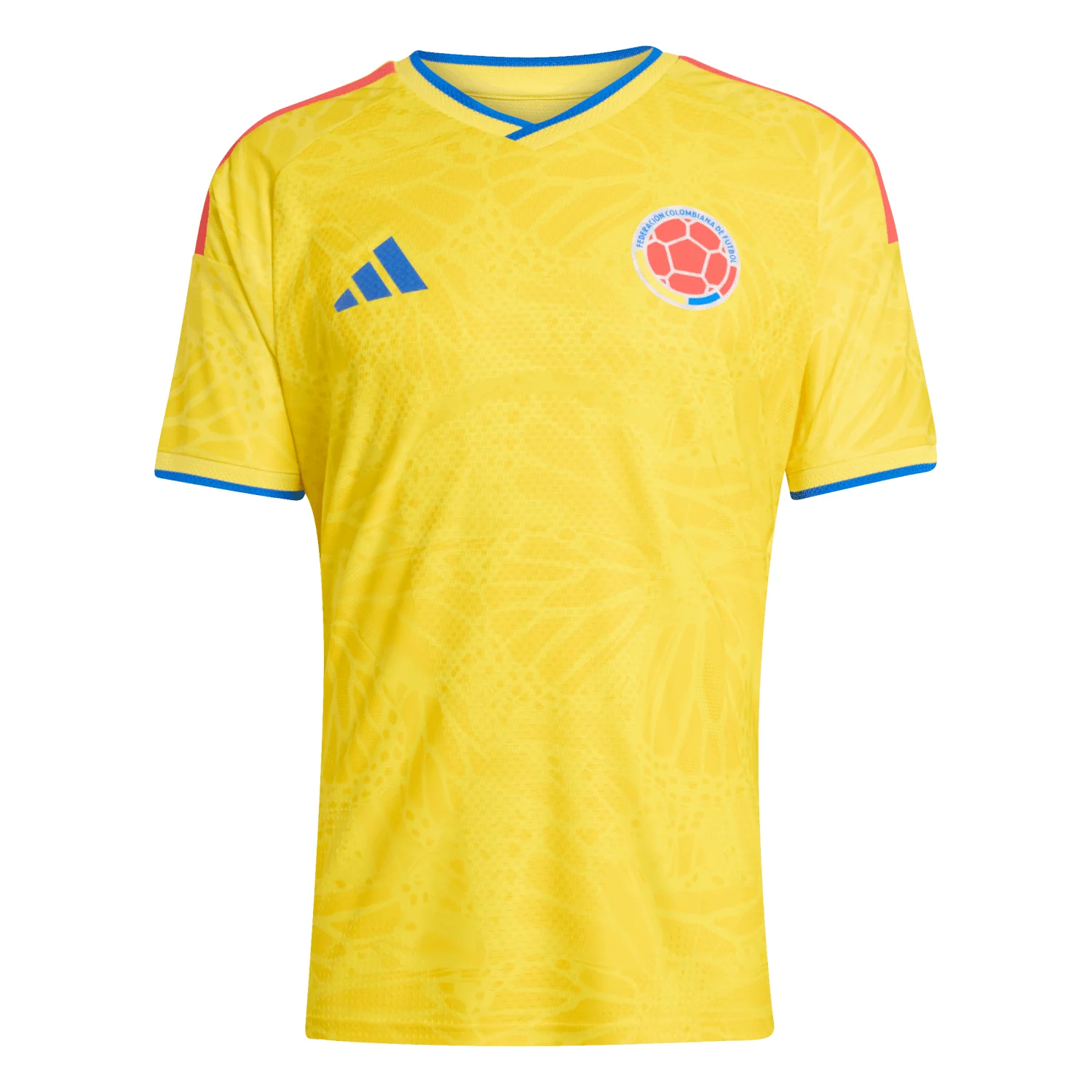
The Colombia national team shirt is one of the most recognisable in world football. Bright yellow, trimmed with the blue and red of the Colombian flag, it stands out on any pitch and in any crowd. Colombia’s team is known as Los Cafeteros, the Coffee Growers, a nickname that comes from the country’s famous coffee trade, and the shirt has become a symbol of Colombian pride far beyond football. This guide explains why Colombia wear yellow, how the shirt became famous through the golden generation of the 1990s and the unforgettable 2014 World Cup, and what to look for if you want one for your own collection.
Why does Colombia wear yellow?
The answer is in the flag. Colombia’s flag has three horizontal stripes: yellow, blue and red, with the yellow stripe twice as wide as the other two. The national team shirt takes that yellow as its base, usually with blue and red trim on the collar, sleeves or sides. The home shirt is almost always yellow, while away shirts have rotated through blue, red and white over the years. It is a simple design idea that works: the yellow is bold, it photographs well, and it is instantly linked to Colombia. Fans often wear the yellow shirt with jeans or shorts away from the stadium too, because it works as a bright summer shirt as much as a football shirt.
The golden generation of the 1990s
The Colombia shirt first became famous around the world in the 1990s, thanks to a golden generation of players led by Carlos Valderrama. Valderrama, the midfielder with the famous blond afro hair, wore the No. 10 shirt and was the team’s playmaker for more than a decade. Around him were players like Faustino Asprilla, Freddy Rincon and goalkeeper Rene Higuita, whose wild, adventurous style made Colombia one of the most entertaining teams to watch. At Italia 90, Colombia reached the World Cup knockout stage for the first time, drawing 1-1 with West Germany thanks to a late Rincon equaliser. Four years later at USA 94, expectations were huge and the team went out in the group stage, a disappointment that is still remembered in Colombia. The shirt from that era, with its bold yellow and its big 1990s fit, is now one of the most collected South American shirts.
The scorpion kick and the shirt’s fame
One moment did more than any other to make the Colombia shirt famous: Rene Higuita’s scorpion kick. In a friendly against England at Wembley in 1995, Higuita dived forward and kicked the ball away with both heels over his head, a save that was shown on television around the world. He was wearing the yellow Colombia shirt, and the image of that save in that shirt is still replayed today. It captured what people loved about that Colombia team: skill, confidence and a willingness to try something nobody else would dare.
Copa America 2001: champions at home
Colombia’s greatest triumph came at home in 2001, when they hosted and won the Copa America. Colombia won the tournament without conceding a single goal, beating Mexico 1-0 in the final in Bogota. It remains Colombia’s only Copa America title, and the yellow shirt from that tournament is a treasured one for Colombian fans. The victory mattered beyond football: it gave the country a moment of shared pride at a difficult time, and the players in yellow became national heroes.
2014: James Rodriguez and the best Colombia shirt era
The Colombia shirt’s modern golden age came at the 2014 World Cup in Brazil. A young James Rodriguez wore the No. 10 shirt and won the Golden Boot as the tournament’s top scorer with six goals. His volley against Uruguay in the round of 16, chesting the ball down and striking it first time, was voted the goal of the tournament. Colombia reached the quarter-finals for the first time, losing 2-1 to hosts Brazil, but the team won admirers everywhere with their attacking football and their celebrations. The 2014 yellow shirt, with James’s name and No. 10 on the back, became one of the best-selling national team shirts of that World Cup.
Colombia and the 2026 World Cup: a preview
Colombia are back on the World Cup stage in 2026, and the yellow shirt will be there again. As a preview, not a prediction: expect the classic yellow home shirt with blue and red trim, and expect the No. 10 to be a talking point, as it always is for Colombia. The 2026 shirt is a chance for a new generation of Colombian players to add their own chapter to the shirt’s story, and for fans it is the latest version of a design that has barely needed to change in decades. If you are choosing a Colombia shirt for 2026, the home yellow is the safe and classic choice, and it is the one that will be recognised instantly anywhere in the world.
How to choose and wear a Colombia shirt
A Colombia shirt is one of the easiest national team shirts to wear. The yellow works with dark jeans, navy shorts or black trousers, and the shirt’s bright colour means it does not need much else. For fit, the standard sizes run from S to XXXL, and the advice is the same as for any football shirt: if you want a relaxed fan fit, take your usual size; if you want a tighter match fit, consider sizing down. Look after the shirt like any printed football shirt: wash it inside out in cold water, skip the tumble dryer, and never iron directly over the badge or the name and number. The yellow fabric shows stains more easily than a dark shirt, so that care matters.
The Colombia shirt has earned its place among football’s great national team designs. From Valderrama’s golden generation to James Rodriguez in 2014, the yellow shirt has carried some of the most entertaining football the World Cup has seen. You can browse the Colombia shirts and the rest of the national team collection in the ElevenKick shop.