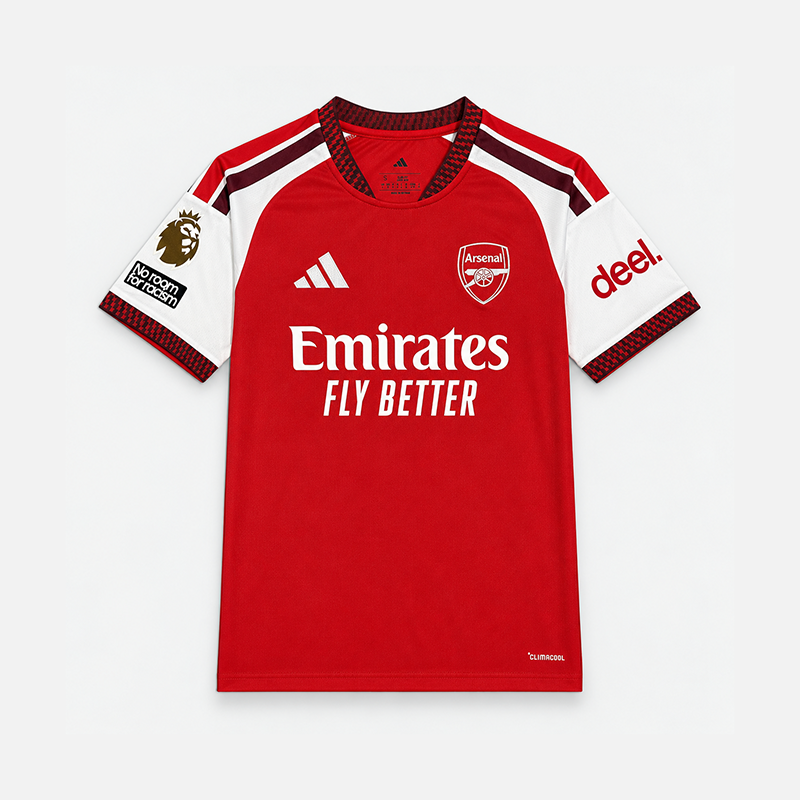
Ask a football fan to picture Arsenal and the image arrives instantly: a red shirt with white sleeves. It is one of the most recognisable kits in world football, and it has barely changed in its essentials for almost a century. That consistency is the point. While other clubs have chased fashion, Arsenal have guarded a simple idea — red body, white sleeves, and a cannon on the chest — and turned it into an identity. This guide traces how that shirt came to be, how it has evolved through the club’s great eras, and what to look for when you choose one for yourself.
From Woolwich to Highbury: where the red shirt began
Arsenal began life in 1886 as Dial Square, a team formed by workers at the Royal Arsenal armaments factory in Woolwich, south-east London. The club soon took the Arsenal name, and its early shirts were red — a colour borrowed, according to club lore, from Nottingham Forest, who donated a set of kits. Red stuck. When the club moved north to Highbury in 1913, the shirt moved with it, and the ground would become inseparable from the kit’s story. For the first decades the shirt was a plain red, worn with white shorts, and it looked much like many other teams of the era. The detail that made it Arsenal came later.
Herbert Chapman and the white sleeves
The most famous decision in Arsenal kit history belongs to Herbert Chapman, the manager who transformed the club in the 1920s and early 1930s. Chapman is credited with adding white sleeves to the red shirt, creating the look that defines Arsenal to this day. The story goes that he was inspired by seeing someone in a red sweater with white sleeves, and he believed the contrast would make his players easier to spot on the pitch. Whether the anecdote is exact in every detail, the change itself is well documented, and it gave Arsenal a shirt that was instantly different from every other red team in England. Chapman also introduced the idea of numbered shirts in English football, and he pushed the club toward the modern, professional identity that the kit came to represent. The white sleeves have survived almost every redesign since, and any Arsenal shirt without them feels, to supporters, like something is missing.
The great eras in red and white
The shirt has been present for every chapter of Arsenal’s success. In the 1930s, Chapman’s side won league titles in the new look, establishing Arsenal as England’s dominant club of the decade. In 1971, the Double-winning team wore red and white as they beat Liverpool in the FA Cup final at Wembley. In 1989, the famous title win at Anfield — Michael Thomas scoring in the final minute to snatch the league from Liverpool on goal difference — was achieved in the yellow away shirt, a reminder that Arsenal’s away kits have their own cult following. The 1990s and 2000s brought the Wenger era, and with it some of the most loved Arsenal shirts of all: the bruised-banana away shirt of the early 1990s, the redcurrant shirt worn in the final season at Highbury in 2005-06, and the simple, elegant home shirts of the Invincibles season of 2003-04, when Arsenal went an entire Premier League season unbeaten. That Invincibles shirt — red body, white sleeves, gold trim — remains one of the most sought-after Arsenal shirts among collectors, because it represents a feat no other Premier League team has matched.
Why the design barely changes
Arsenal’s home shirt changes in small ways each season: a different collar, a new shade of red, a subtle pattern in the fabric, a refreshed sponsor or badge. The fundamentals do not move. That restraint is deliberate. Supporters expect to recognise an Arsenal shirt from across a stadium, and the club knows that the white sleeves are sacred. Designers therefore play in the margins — a darker red, a tonal cannon pattern, a retro collar — rather than reinventing the shirt. Away and third shirts carry the experiments: yellow, blue, black, and more adventurous patterns, which is why away shirts often become collector favourites. If you want a shirt that will still look right in ten years, the home shirt is the safe choice. If you want a talking point, look at the away designs.
Choosing an Arsenal shirt
When you choose an Arsenal shirt, start with the fit you actually wear. Modern fan shirts are cut for everyday wear, looser than the tight player versions, and they suit most supporters better for daily use. Check the size guide and measure a shirt you already own rather than guessing, because sizes vary between seasons and manufacturers. Think about colour: the home red works with jeans, dark trousers, and shorts alike, and the white sleeves keep it bright without being loud. If you plan to wear it to matches, consider the away or third shirt for variety, but if this is your first Arsenal shirt, the home shirt is the one that says Arsenal most clearly. Look after it the way you would any favourite shirt: wash cold, turn it inside out, and let it air dry rather than tumble drying it, so the badge and print stay sharp.
The cannon, the badge, and the details
Arsenal’s cannon badge is one of football’s oldest symbols, a direct link to the club’s origins at the armaments factory. It has been redrawn many times — from a detailed cannon pointing in different directions to the clean modern crest introduced in 2002 — but the cannon has never left. Modern shirts carry the crest over the heart, and the details around it, from the collar to the sleeve trim, are where each season’s design earns its character. Collectors often judge a shirt by these small things: the shape of the collar, the shade of red, the way the badge sits. For a first-time buyer, the advice is simpler: if it is red, with white sleeves, and the cannon is on the chest, it is Arsenal, and it will be recognised as such anywhere in the world.
Closing
The Arsenal shirt endures because it was designed around an idea rather than a fashion. Red body, white sleeves, cannon on the chest — that is the whole formula, and it has carried the club from Woolwich to Highbury to the Emirates Stadium. Whether you are buying your first Arsenal shirt or adding to a collection, start with the home shirt and let the story do the rest. You can browse the full range of football shirts in the ElevenKick shop and find the Arsenal shirt that fits your collection.