Brazil’s yellow shirt is the most famous shirt in football. It has been worn by five World Cup-winning teams, and it is recognised in every country on earth. But the most loved Brazil shirt of all belongs to a team that did not win the World Cup. The Brazil team of 1982, in their yellow shirts with green trim, played football so beautiful that it changed what people expected from the game — and the shirt they wore became a legend.
The team that played the beautiful game
Brazil arrived at the 1982 World Cup in Spain as favourites, and they played like it. Their coach, Tele Santana, believed that football should be played with flair, with attacking intent, and with joy. His team was built around four midfielders who are still spoken about with awe: Zico, Socrates, Falcao and Toninho Cerezo. Behind them played Junior, one of the great attacking full-backs, and up front was Eder, whose left foot could do almost anything.
The football they played was free and flowing. Players swapped positions, attacked in numbers, and scored goals that looked effortless. In the first group stage they beat the Soviet Union, Scotland and New Zealand, scoring ten goals in three matches. It was the kind of football that made neutrals fall in love with the team, and it made the yellow shirt the most wanted shirt of the tournament.
The yellow shirt of Spain 82
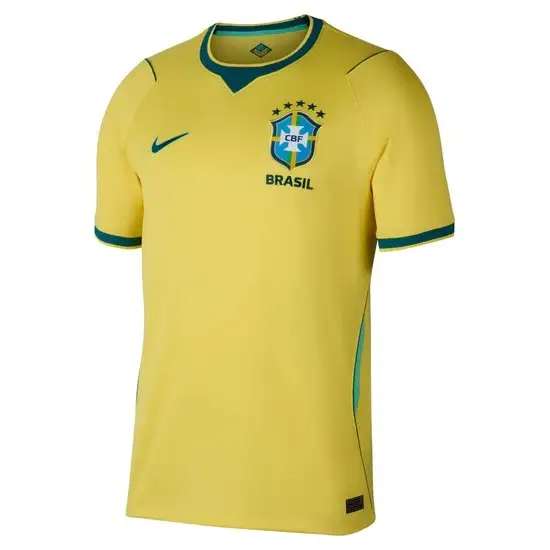
The Brazil shirt of 1982 was a simple design: a bright yellow shirt with green trim on the collar and cuffs, the crest of the Brazilian federation over the heart, and the number on the back in green. It was worn with green shorts and white socks, the classic Brazil combination. There was nothing flashy about it. The shirt did not need to be flashy — the football did the talking.
That simplicity is part of why the shirt endures. It is the pure Brazil look, with no distractions. The yellow is the yellow of the Brazilian flag, a colour that stands for the country’s wealth and warmth. The green trim is the green of the flag, standing for the forests of Brazil. Together they make a shirt that is instantly, unmistakably Brazil.
The match that broke hearts
Brazil’s run ended in the second group stage, in a match that is still talked about today. They faced Italy in Barcelona on 5 July 1982, and they needed only a draw to reach the semi-finals. Italy needed a win. Paolo Rossi, the Italian striker, scored a hat-trick, and Italy won 3-2 in one of the greatest World Cup matches ever played.
Brazil had played the more beautiful football, but Italy had been more ruthless. The defeat is still felt in Brazil today, and it is often described as the day football died — the day the beautiful game lost to pragmatism. But the defeat only added to the legend of the team and the shirt. The 1982 side never won the World Cup, yet they are remembered more fondly than many teams that did.
Why the 1982 shirt is a collector’s favourite
For collectors, the 1982 Brazil shirt sits at the top of the list of retro national-team shirts. It represents a team, a style and a moment in football history that will never be repeated. It is the shirt of Zico’s free kicks, of Socrates’ backheels, of Falcao’s thunderbolt against Italy — a goal so powerful that it seemed to shake the stadium.
The shirt is also a reminder of a different era of football. The 1982 shirts were made of heavier cotton, with a simple cut and a collar that sat flat. They were not designed for speed or for technology; they were designed to be worn, and to be recognised. That is why they still look right today, more than forty years later.
The players who wore it
Zico, known as the White Pele, was the star of the team — a playmaker with a free kick that could bend around any wall. Socrates was the captain, a tall, elegant midfielder with a beard and a medical degree, who played the game like a philosopher. Falcao was the King of Rome, a midfielder who had starred for Roma in Italy. Eder scored one of the great World Cup goals against the Soviet Union, a volley struck with such power and precision that it is still replayed today.
Each of them wore the yellow shirt, and each of them made it more famous. For fans who collect player shirts, a 1982 Brazil shirt with the number 10 of Zico or the number 8 of Socrates is one of the great prizes of the hobby.
The legacy of the beautiful game
Brazil went on to win the World Cup again in 1994 and 2002, but neither team played with the freedom of 1982. The 1982 side remains the standard against which all Brazil teams are judged, and the standard against which all attacking football is judged. When people talk about the beautiful game, they are talking about the football that team played in that yellow shirt.
That is why the shirt matters. It is not just a retro design; it is a symbol of an idea — that football can be beautiful, that winning is not the only thing that matters, and that a team can lose and still be loved forever.
Adding the 1982 shirt to your collection
If you are building a collection of classic World Cup shirts, the 1982 Brazil shirt belongs in it. Look for the bright yellow with green trim, the simple crest, and the clean lines of the era. It pairs beautifully with other classic Brazil shirts, and it is a shirt that every football fan recognises instantly.
You can explore our vintage and retro jerseys, including the Brazil 1970 Retro Jersey — another classic Brazil shirt from the golden era — and the rest of our shop. Some shirts are remembered for the trophies they won. This one is remembered for the football it played.