
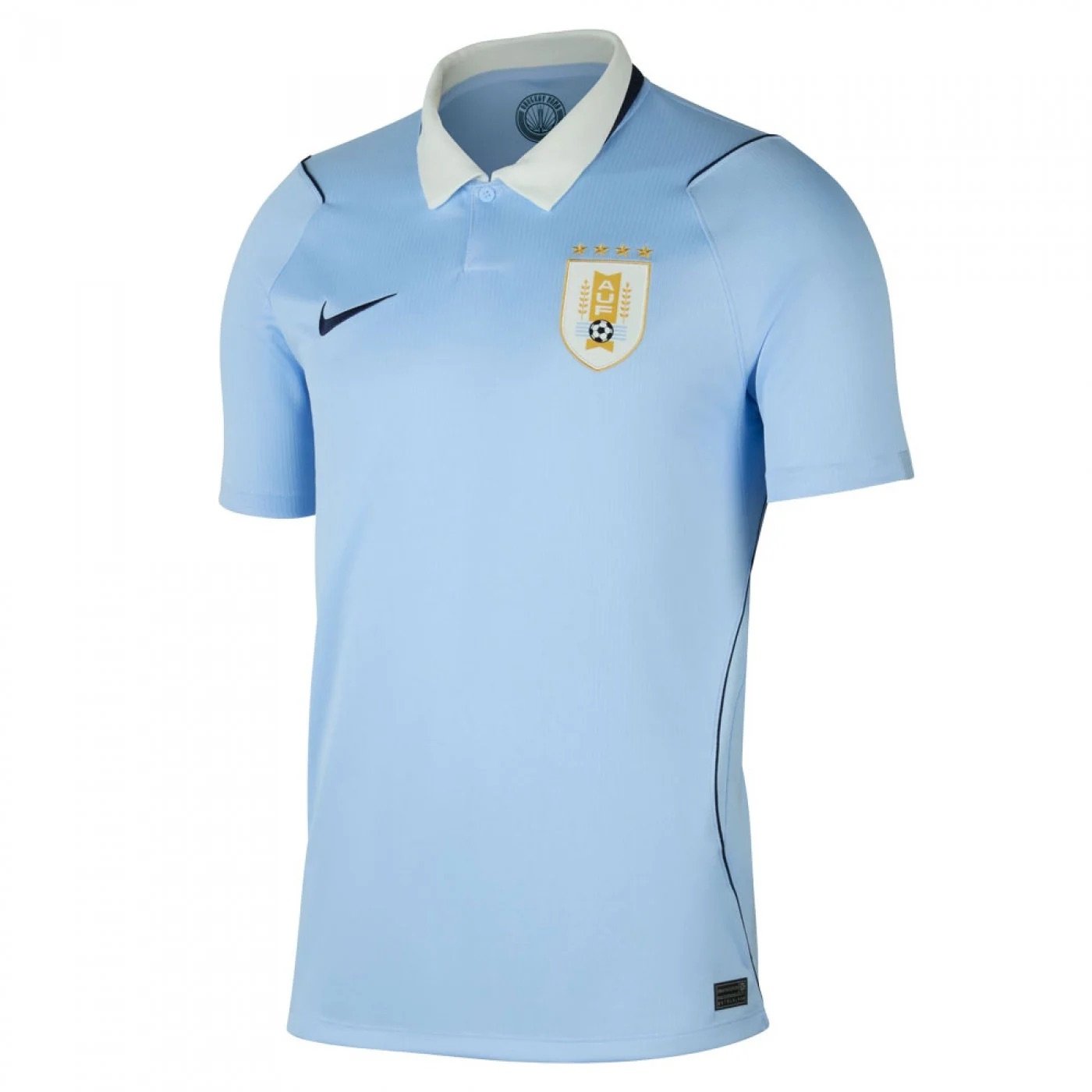
Uruguay is a small country with a giant football history, and its sky-blue shirt tells that story at a glance. Known as La Celeste, meaning the Sky Blue, Uruguay won the first ever World Cup in 1930 and shocked the world again in 1950. This guide explains the shirt, the stars, and the players who made it famous.
A small nation, a huge football history
Uruguay’s football association was founded in 1900, and the national team quickly became one of the strongest in South America. The sky-blue shirt became the team’s identity in the early years of the twentieth century, and it has stayed ever since. The colour is light, calm and instantly different from the red, white and blue worn by most national teams. When Uruguay walk out in sky blue, fans everywhere know exactly who they are.
1930: the first World Cup winners
Uruguay hosted and won the first FIFA World Cup in 1930, beating Argentina 4-2 in the final in Montevideo at the Estadio Centenario, a stadium built for the tournament. That victory made Uruguay the first world champions in football history, and the sky-blue shirt became a symbol of that achievement. The Centenario remains Uruguay’s home stadium and a place of pilgrimage for football fans, a concrete reminder that the modern World Cup began in Montevideo.
1950 and the Maracanazo
Twenty years later Uruguay produced one of the greatest upsets in football history. At the 1950 World Cup in Brazil, Uruguay beat the host nation 2-1 in the final match at the Maracana Stadium in Rio de Janeiro, in front of a huge home crowd expecting a Brazilian win. The match is known as the Maracanazo, and it is still talked about as the most famous result in World Cup history. The sky-blue shirt worn that day became legendary, and it is one of the most respected shirts in the sport.
Why four stars sit above the crest
Look closely at the Uruguay crest and you will see four stars. Two represent the World Cup victories of 1930 and 1950. The other two represent Uruguay’s Olympic football titles of 1924 and 1928, tournaments that were effectively the world championships of their time, before the World Cup existed. No other national team crest tells its history quite like that. The stars are a reminder that Uruguay’s success is not a recent story, but a century-long one.
The classic Uruguay kit
The classic Uruguay home kit is simple: a sky-blue shirt, black shorts and sky-blue socks. That combination has barely changed in decades, which is part of its charm. Away kits have varied, often using white or darker colours, but the home shirt is the one every fan recognises. Modern versions use lighter fabrics and a slimmer fit, but the colour and the clean design remain the same. It is a shirt that looks just as good in the stands as it does on the pitch.
The players who wore the sky blue
Uruguay’s shirt has been worn by generations of tough, skilful players. In recent decades Luis Suarez and Edinson Cavani became two of the most feared strikers in world football, while Diego Forlan was named the best player of the 2010 World Cup. Diego Godin captained the team with authority in defence, and Federico Valverde carries the midfield tradition forward today. Each of them wore the same sky-blue shirt, connecting the modern team to the champions of 1930 and 1950.
Uruguay and the Copa America
Uruguay’s World Cup story is only part of its history. In South America’s own championship, the Copa America, Uruguay has been one of the most successful nations of all time, winning the tournament 15 times. That record spans from the early years of the competition right through to 2011, when Uruguay won the title again in Argentina. For a country with a small population, that level of sustained success is remarkable, and it explains why the sky-blue shirt carries so much respect across South America. The Copa America wins also show a different side of Uruguay: not just the famous World Cup triumphs, but a team that has competed at the top of its continent for more than a century. When fans wear the Uruguay shirt today, they are wearing a shirt connected to that long continental story as well as to 1930 and 1950. It is also a shirt that stands out in any collection of national team kits, because very few nations can match its combination of a distinctive colour, a simple design and a trophy history that stretches back to the very beginnings of international football.
Visiting Montevideo adds another layer to the Uruguay story. The Estadio Centenario, built for the 1930 World Cup, still hosts the national team, and its football museum tells the story of those early triumphs with shirts, trophies and photographs from the era. For travelling fans, a match at the Centenario is a chance to see the sky-blue shirt in its natural home, surrounded by supporters who have followed La Celeste for generations. Even for fans who never make the trip, knowing that the stadium and its history still stand gives the shirt extra meaning: it is not just a design, but a living link to the ground where the World Cup itself began.
If you love football history, the Uruguay shirt belongs in your collection. Browse the national team jerseys at ElevenKick to find your sky-blue shirt.

