Orange Like No Other Team
In international football, most teams wear the colours of their flag. The Netherlands are the glorious exception. Their flag is red, white and blue, yet their shirts are bright orange — a colour so closely tied to the team that fans, players and the whole country are known by it: Oranje. At a Netherlands match, the stands become a sea of orange, the streets fill with orange flags and face paint, and the colour itself becomes a celebration.
This guide explains why the Netherlands wear orange, how the shirt has evolved, and which Oranje shirts fans remember best.
Why Orange? The House of Orange
The answer lies in Dutch history. The Netherlands’ royal house is the House of Orange-Nassau, and orange has been the country’s national colour for centuries, long before the modern football team existed. William of Orange, the leader of the Dutch revolt against Spanish rule in the sixteenth century, gave his name to the dynasty, and orange became the colour of Dutch pride, celebration and identity. It is the colour worn on King’s Day, the national holiday when the whole country dresses in orange.
So when the Netherlands football team took the field, orange was the natural choice. It was not a fashion decision; it was a statement of who they are. Few national teams in world football have a kit colour with such a deep historical root, and none wear theirs with quite the same joy.
Total Football and the Shirts of the 1970s
The Netherlands shirt became world-famous in the 1970s, when the national team, coached by Rinus Michels and inspired on the pitch by Johan Cruyff, introduced the world to Total Football — a fluid, attacking style in which players swapped positions and pressed as a team. The Dutch reached the World Cup finals in 1974 and 1978, losing both times, but they won admirers everywhere. The orange shirts of those tournaments, with their simple design and black trim, are now among the most beloved retro shirts in football.
Cruyff himself is central to the story. His famous number 14 shirt, his turn against Sweden in 1974, and his elegant, intelligent play made the orange shirt a symbol of beautiful football. Even fans who never saw those teams play know the image: a Dutch player in orange, gliding past opponents, playing football the way it was meant to be played.
1988: The Year Orange Finally Won
For all their beautiful football, the Netherlands had a reputation for glorious failure — until the summer of 1988. At the European Championship in West Germany, a Dutch team featuring Ruud Gullit, Marco van Basten and Frank Rijkaard finally turned style into silverware. Gullit scored in the final against the Soviet Union, and Van Basten scored one of the greatest goals in football history, volleying home from an almost impossible angle.
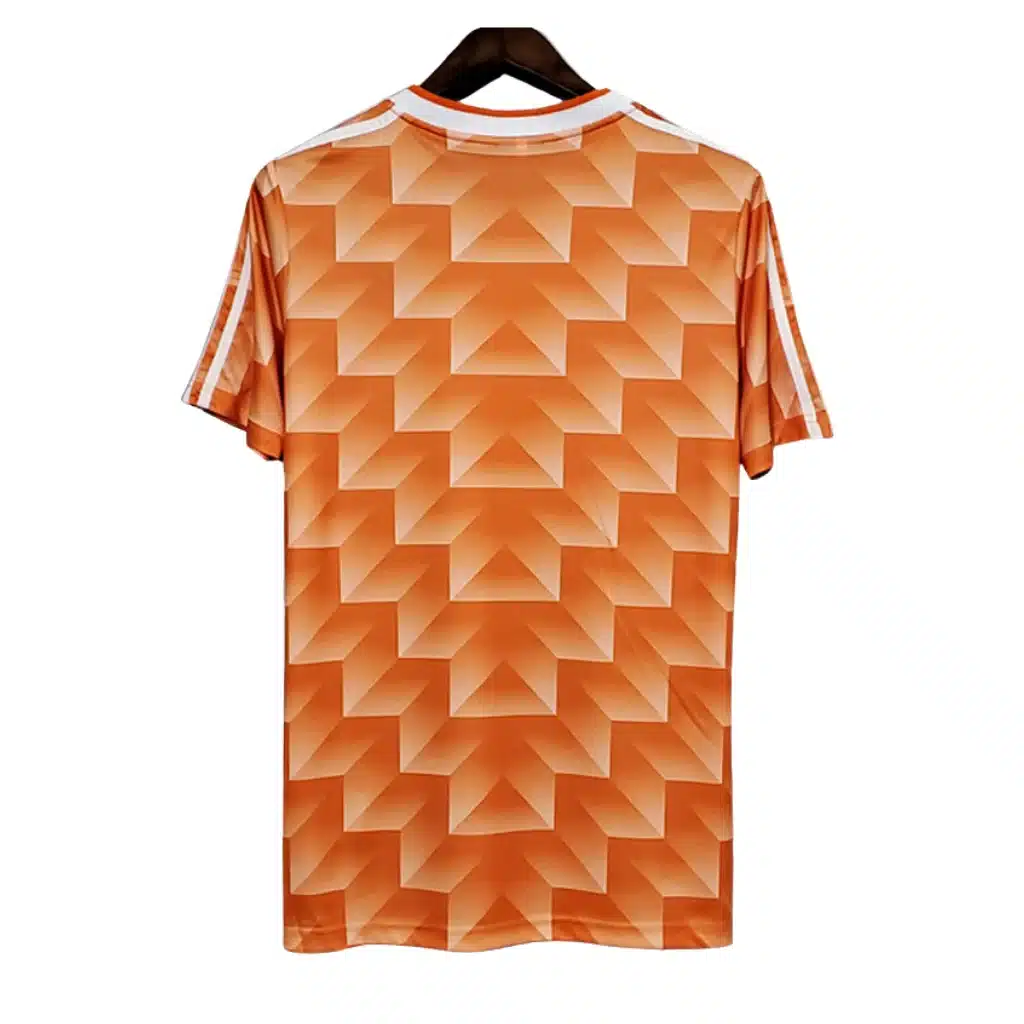
The shirt of 1988, with its distinctive geometric pattern, has become a design classic in its own right. Fans still seek it out, and its pattern is instantly recognisable even to people who were not born when the final was played. That tournament proved what Dutch fans had always believed: orange was not just a colour for entertaining losers. It was the colour of champions.
Near Misses, New Heroes and the Modern Shirt
Since 1988, the Netherlands have remained one of Europe’s great teams, even without adding another major trophy. They reached the World Cup final again in 2010, losing to Spain in South Africa, and they have produced a steady stream of stars, from Dennis Bergkamp and Clarence Seedorf in the 1990s to Arjen Robben, Robin van Persie and Virgil van Dijk in more recent years. Each generation has worn its own version of orange, and each version has kept the same promise: bright, bold and unmistakably Dutch.
Modern Netherlands shirts tend to be cleaner and more streamlined than the patterned classic of 1988, but the colour never changes, and neither does the feeling. Whether the trim is black, white or a darker shade of orange, the shirt is always, first and foremost, orange.
Wearing Oranje
A Netherlands shirt is one of the most versatile national-team shirts a fan can own. Orange works surprisingly well as a casual colour: it pairs with denim, with black, with white and with navy, and it always stands out in a crowd. It is also a perfect tournament shirt, because no fan group in world football creates a spectacle quite like the Dutch. The travelling Oranje army, with its orange hats, wigs and banners, is famous for turning away matches into festivals.
To keep an orange shirt looking bright, wash it inside out in cool water, avoid bleach and strong detergents, and let it air dry out of direct sunlight. Bright colours reward gentle care, and a well-kept orange shirt will stay vivid for years.
More Than a Colour
The Netherlands shirt matters because it is more than a kit. It connects football to Dutch history, to the House of Orange, to King’s Day, to Total Football and to the heroes of 1988. It is a shirt that turns a football match into a national celebration, and a colour that turns a crowd into a single, joyful wall of orange.
Browse the Netherlands shirts and the full national-team range at the ElevenKick shop, and find your own piece of Oranje.