
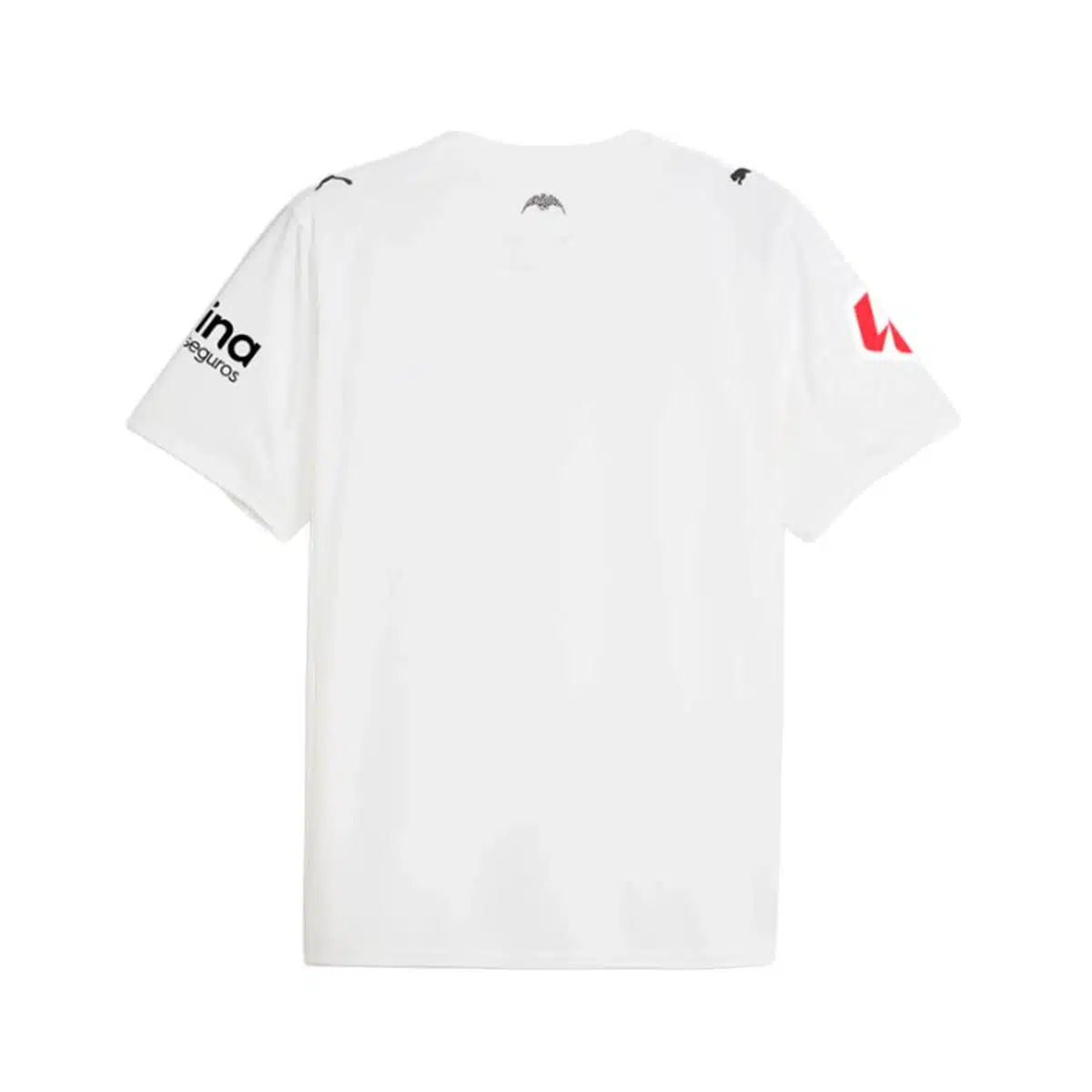
In a league of red-and-blue stripes and famous colours, Valencia stand out by wearing almost no colour at all. Their home shirt is white — plain, clean, brilliant white — worn at the Mestalla, one of the great stadiums of Spanish football. It is a shirt with more than a century of history behind it, and a story that runs through league titles, European finals, and some of the finest players Spain has ever produced.
This is the story of the Valencia soccer jersey: the white shirt, the bat on the crest, and the team that made it famous.
Why Valencia wear white
Valencia CF were founded in 1919, and the white shirt has been theirs from the start. The club’s colours are white and black: white shirt, black shorts, white socks — a look that has barely changed in over a hundred years. In a league where Barcelona wear blue and garnet, Real Madrid wear white too, and Atlético wear red and white stripes, Valencia’s all-white home kit is a statement of simplicity.
The club’s crest carries one of football’s most unusual symbols: a bat. The bat of Valencia — el murciélago — comes from the city’s own history and coat of arms, and it sits above the club’s shield on the shirt. The nickname Los Che comes from the Valencian word “che”, a local expression fans use with each other. The white shirt, the bat, and the nickname together make Valencia one of the most distinctive identities in Spanish football.
The golden years: Benítez and the double
Valencia’s greatest era came at the turn of the millennium, under coach Rafael Benítez. In the 2001-02 season, Valencia won La Liga — their first league title in 31 years — wearing the white shirt, and they did it again in 2003-04. That same 2003-04 season they also won the UEFA Cup, beating Marseille 2-0 in the final in Gothenburg, completing a league and European double that remains the club’s finest achievement.
The team of that era was built on a rock-solid defence and a brilliant midfield. Santiago Cañizares was the goalkeeper, Roberto Ayala and Mauricio Pellegrino the centre-backs, and David Albelda the shield in front of them. Rubén Baraja and Pablo Aimar drove the side forward, and Mista scored the goals. The white shirt of those seasons — with the Terra Mítica sponsor across the chest — is the one Valencia fans reach for when they talk about the club at its best.
Two Champions League finals
Before the Benítez titles, Valencia had already made their mark on Europe. In 2000, they reached the Champions League final, beating Barcelona and Lazio on the way, before losing 3-0 to Real Madrid in Paris. A year later, in 2001, they reached the final again — this time losing on penalties to Bayern Munich in Milan after a 1-1 draw.
Reaching two consecutive Champions League finals is a rare achievement, and it put Valencia’s white shirt on the biggest stage in club football. The players who wore it in those finals — Gaizka Mendieta, the elegant midfielder and captain; Kily González; Claudio López; and goalkeeper Cañizares — are still remembered as the heroes of that generation. Mendieta, in particular, is a Valencia legend: a midfielder of rare grace who wore the white shirt with distinction and was named in the team of the tournament at Euro 2000 with Spain.
Kempes, Villa, Silva and Mata
A shirt is only as famous as the players who wear it, and Valencia’s white has been worn by some of the finest footballers of their generations. Mario Kempes, the Argentine striker who won the World Cup in 1978, wore it in the late 1970s and early 1980s and won the Pichichi Trophy as La Liga’s top scorer twice. He remains one of the most loved players in the club’s history.
In the modern era, the white shirt was the launchpad for a generation of Spanish stars. David Villa, who went on to become Spain’s all-time leading goalscorer and a World Cup winner in 2010, made his name at Valencia. David Silva and Juan Mata, both World Cup winners with Spain in 2010, came through at the Mestalla in the white shirt. For Spanish football fans, the Valencia white shirt is where that golden generation of Spanish players learned their trade.
The Mestalla and the white shirt
No story of the Valencia shirt is complete without the Mestalla. The club’s stadium, opened in 1923, is one of the steepest and loudest grounds in Spain — a bowl where the fans sit almost on top of the pitch. When Valencia play at home, the white shirts stand out brilliantly against the dark stands, and the noise from the Mestalla has intimidated visiting teams for a century.
The shirt and the stadium belong together. The white of Valencia is the white of the Mestalla on a Saturday night: bright, proud, and unmistakable. It is a shirt that looks best under floodlights, in front of a full house, with the bat on the crest and the city behind it.
Wearing the Valencia shirt today
The white Valencia shirt is one of the easiest club shirts to wear. It goes with anything — jeans, black shorts, dark trousers — and the clean white design works in every season. Because the design is so simple, it never looks dated: a Valencia shirt from ten years ago looks as good as one from today.
For collectors, the white shirt is a smart pick. It is a La Liga classic with a real history behind it — league titles, a UEFA Cup, two Champions League finals, and a roll call of players from Kempes to Villa, Silva and Mata. It sits proudly in any collection of Spanish football shirts, and it stands out precisely because it refuses to shout.
Why the white shirt belongs in a collection
Not every famous shirt needs stripes or a bold colour. Valencia prove that a plain white shirt, worn with pride for over a century, can be one of the most iconic in football. The bat on the crest, the noise of the Mestalla, and the memories of Mendieta, Kempes, Villa and Silva give the shirt a story that few clubs can match.
If you love Spanish football, or you simply love a classic white shirt with a real history, the Valencia shirt deserves a place in your collection. Browse the ElevenKick shop to find your Valencia shirt and wear the white of Los Che.

