
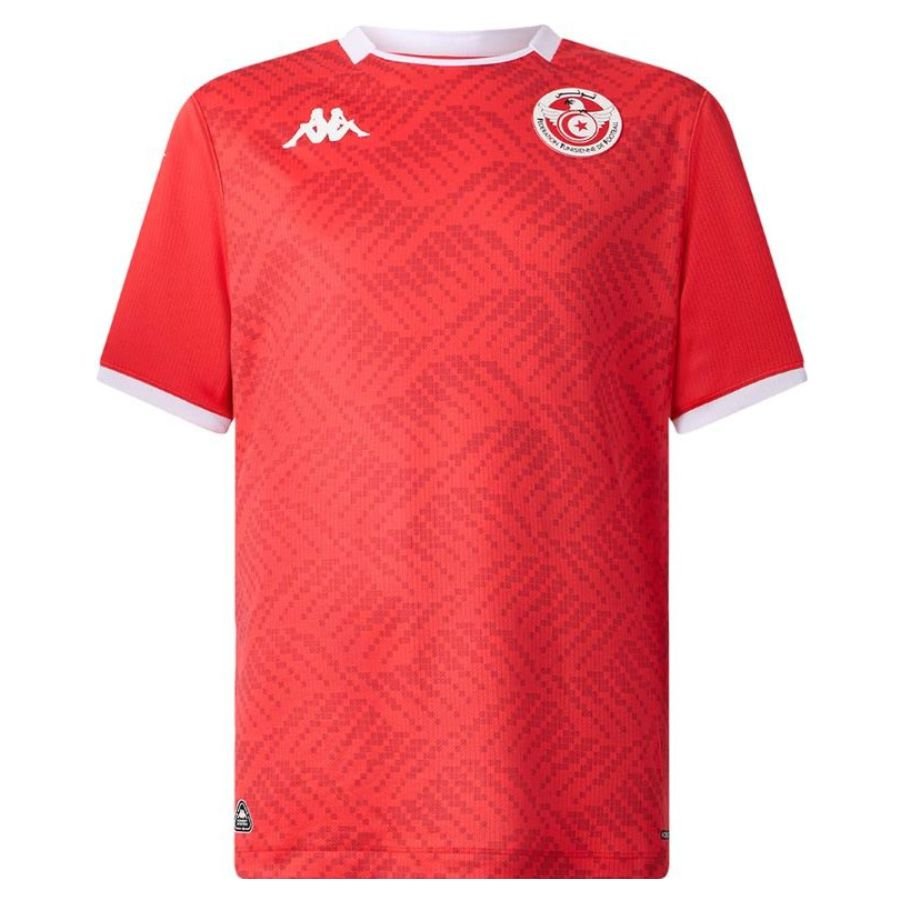
The red shirt of Tunisia carries a proud piece of football history. Tunisia were the first African team ever to win a match at the World Cup, and their fans, the Carthage Eagles, have followed the team to seven World Cups. With the 2026 tournament coming to North America, the red shirt is back on the world stage — and this is the story behind it.
The Carthage Eagles
Tunisia’s national team are known as the Carthage Eagles, Les Aigles de Carthage in French. The name reaches back to Carthage, the great ancient city that stood near modern Tunis, and the eagle is a symbol of strength and pride. The nickname fits the way Tunisian fans see their team: proud, stubborn and hard to beat. Football is the biggest sport in Tunisia, and the national team is a source of unity in a country where the game is followed everywhere, from the cafes of Tunis to the towns of the south. When the Eagles play, the whole country watches, and the red shirt is the colour of that support.
Red, white and the colours of the flag
Tunisia’s home shirt is red, with white trim, matching the red and white of the national flag. The away shirt is usually white with red details. The design is simple and bold: a solid red shirt, often with white on the collar and sleeves, and the Tunisian crest over the heart. The crest carries the red disc and white crescent of the flag, a reminder that the shirt represents the whole country. In recent years the shirt has kept that clean look, with modern fabrics and a slim fit, but the colours have never changed. A Tunisia shirt is easy to spot in a crowd, and that is exactly the point — in a tournament full of famous colours, the red of Tunisia stands out.
1978: the win that changed African football
The most famous chapter in the history of the Tunisia shirt came at the 1978 World Cup in Argentina. Tunisia were playing at their first World Cup, and few people outside Africa expected much from them. In their opening match against Mexico, Tunisia fell behind, then fought back to win 3-1. It was the first time an African team had ever won a match at the World Cup, and it changed how the world saw African football. The win was so important that FIFA soon increased Africa’s places at the World Cup, opening the door for the generations of African teams that followed. The players who wore the red shirt that day — men like Mokhtar Dhouib, who scored in the win, and the captain Tarak Dhiab — became national heroes. The 1978 shirt, a simple red design with white trim, is still one of the most loved in Tunisian football history, and it is the reason the red shirt carries such weight.
The 2004 Africa Cup of Nations triumph
Tunisia’s greatest trophy came on home soil. In 2004 the country hosted the Africa Cup of Nations, and the Eagles went all the way, beating Morocco 2-1 in the final in front of a packed stadium in Tunis. The goals came from Francileudo Santos and Ziad Jaziri, and the win gave Tunisia their first, and so far only, African title. The team was coached by the Frenchman Roger Lemerre, and the side mixed experienced players with young talent. The red shirt that lifted the trophy in 2004 is remembered by every Tunisian fan, and the tournament is still talked about as the high point of the national team’s history. Reaching the final of the Africa Cup again remains the team’s great ambition, and the 2004 win is the standard every new generation is measured against.
World Cup regulars
Since 1978, Tunisia have become regulars at the World Cup. The team qualified in 1998, 2002 and 2006, then again in 2018 and 2022, and now for 2026 — their seventh appearance at the tournament. The 2018 campaign brought a memorable moment when Wahbi Khazri scored in a 2-1 win over Panama, Tunisia’s first World Cup win in 40 years. At the 2022 World Cup in Qatar, Tunisia beat France 1-0 in their final group match, with Khazri scoring the winner, even though the result was not enough to reach the knockout rounds. Those wins show what the team can do on the biggest stage: Tunisia rarely go to a World Cup and leave without a fight, and the bigger the opponent, the harder the Eagles play. The 2026 tournament is a fresh chance, and the red shirt will be worn with the same pride it has carried since 1978.
The players who made the shirt famous
Several players have become symbols of the Tunisia shirt. Wahbi Khazri, the attacking midfielder and captain in recent years, has been the team’s creative heart, scoring important goals at two World Cups. Youssef Msakni, the skilful winger, has been a star of the team for more than a decade. Ellyes Skhiri, the midfielder who plays his club football in Germany, brings energy and discipline to the side. In goal, Aymen Mathlouthi was a long-serving captain and one of the most respected keepers in African football. Going further back, Tarak Dhiab, the star of the 1978 team, is still considered one of the greatest Tunisian players of all time, and Francileudo Santos, born in Brazil but a Tunisian international, scored the goals that won the 2004 Africa Cup. Each of them wore the red shirt, and each of them added something to its story.
The shirt at the 2026 World Cup
The 2026 World Cup is the biggest in history, played across the United States, Canada and Mexico, and Tunisia are there as one of Africa’s representatives. For fans, the tournament is a chance to see the red shirt on the world stage again, and for collectors it is a chance to own the shirt of a team with a genuine place in World Cup history. The 2026 shirt keeps the classic look — red, with white trim and the Tunisian crest — and it is the shirt the Eagles will wear as they try to reach the knockout rounds for the first time. Whatever happens in the tournament, the shirt itself is already a classic: simple, bold and full of meaning. This guide is a preview only — the 2026 World Cup has not been played yet, and the story of this shirt at the tournament is still to be written.
Why the Tunisia shirt belongs in a collection
For a collector, the Tunisia shirt offers something different from the usual big names. It is the shirt of a team that made history for a whole continent, that has won an Africa Cup of Nations, and that turns up at World Cup after World Cup. The red is striking, the design is clean, and the story behind it — the first African World Cup win, the 2004 triumph, the wins over France and Panama — gives it a depth that few shirts can match. It also pairs well with other African national team shirts, making it a strong choice for fans building a collection that covers the whole continent. A Tunisia shirt is not just a red shirt. It is a piece of African football history.
How to wear the Tunisia shirt
The solid red of the Tunisia shirt works best with simple, dark colours. Black shorts and dark jeans let the red stand out, and a white or black jacket over the top keeps the look clean. On a matchday, the shirt goes with a Tunisian flag or a red scarf, and nothing more is needed. For everyday wear, the shirt’s bold colour means it should be the centrepiece of the outfit — keep everything else plain and let the red do the work. It is a shirt that looks just as good in the stands as it does on the street.
Tunisia’s red shirt has been part of World Cup history since 1978, and the Carthage Eagles are ready to add a new chapter in 2026. See the shirt for yourself — the Tunisia 2026 World Cup Jersey is in stock at the ElevenKick shop.

