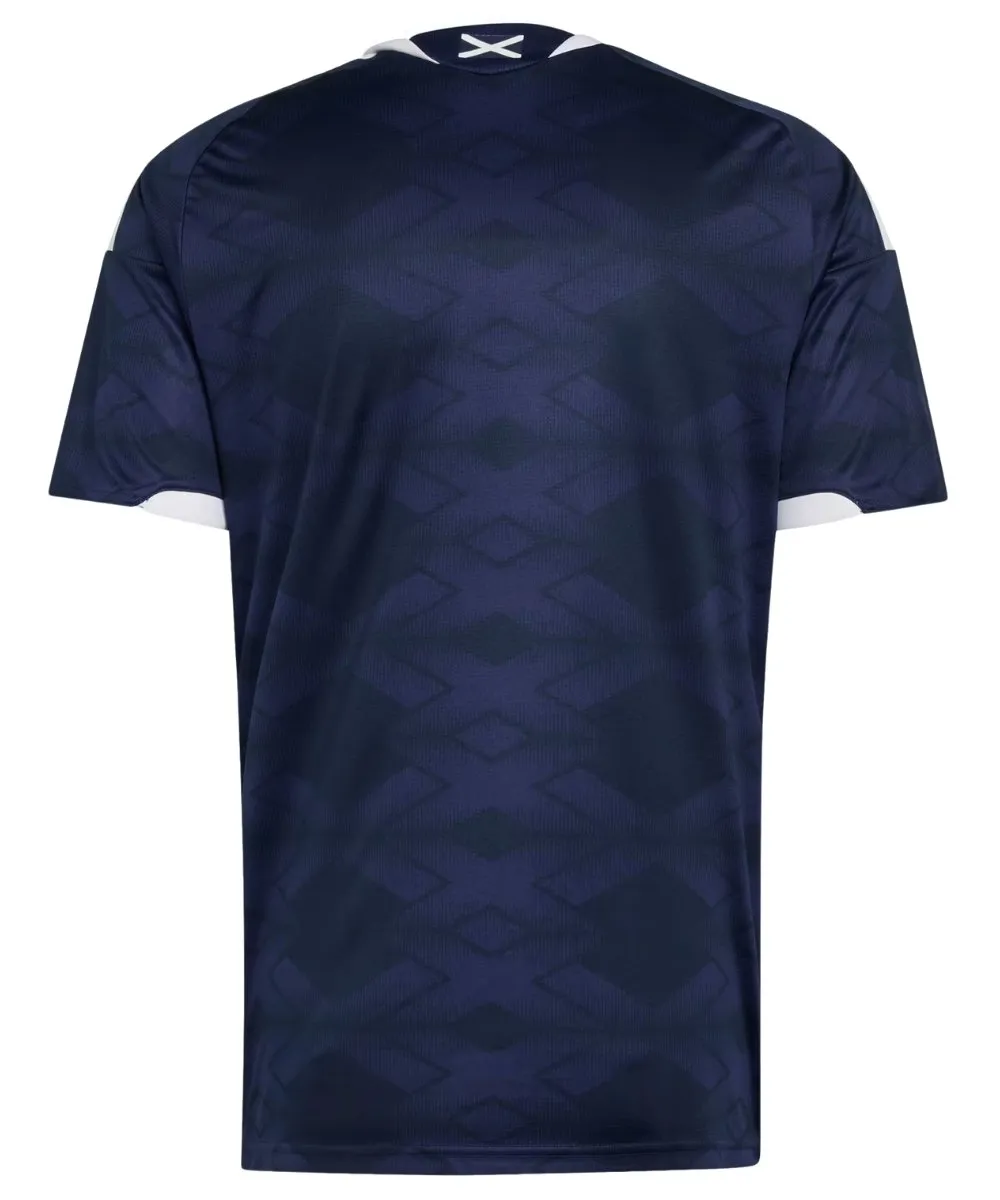
Scotland’s navy blue shirt is one of the oldest and most respected shirts in international football. Scotland played in the very first official international match in history, against England in Glasgow in 1872, and the Scots have worn dark blue ever since. That makes the Scotland shirt more than a kit. It is a piece of football history that is still being worn today, more than 150 years after it all began.
The shirt is a deep navy blue, usually worn with white shorts and navy socks, and it carries the crest of the Scottish Football Association on the chest. It is a simple design, and that simplicity is the point. While other nations have changed their colours and chased new designs, Scotland have stayed loyal to navy blue, and the shirt is instantly recognisable wherever it appears.
The first international match
On 30 November 1872, Scotland met England at Hamilton Crescent in Glasgow, in front of around 4,000 spectators, and the match ended in a 0-0 draw. It was the first official international football match ever played, and Scotland were there at the start of it all. The Scottish players wore navy blue, and the colour has been theirs ever since.
That history gives the Scotland shirt a weight that few other national team shirts can match. When a Scotland player pulls on the navy shirt today, they are wearing the same colour worn by the players of 1872, and by every great Scottish side since. The shirt connects the modern team to the very beginning of international football.
Hampden Park and the Tartan Army
Scotland’s home is Hampden Park in Glasgow, one of the most famous stadiums in world football. On a big night at Hampden, with the crowd singing Flower of Scotland before kick-off, the atmosphere is extraordinary, and the navy blue shirts of the players stand out against the sea of tartan in the stands.
The supporters who follow Scotland everywhere are known as the Tartan Army, and they are famous around the world for their numbers, their good humour and their loyalty. The Tartan Army travel in their thousands to away matches, and they are welcome almost everywhere they go. The navy blue shirt is their uniform too: you will see it in stadiums across Europe and beyond, worn by fans who have followed Scotland through long years of waiting and short bursts of joy.
Eight World Cups and a long wait
Scotland have qualified for the World Cup eight times: in 1954, 1958, 1974, 1978, 1982, 1986, 1990 and 1998. The 1974 side, which went unbeaten in the group stage in West Germany but still went out on goal difference, is remembered with particular affection. The 1978 campaign in Argentina is remembered for the drama, and for Archie Gemmill’s famous goal against the Netherlands. But Scotland have never gone beyond the group stage at a World Cup, and that unfinished business has haunted Scottish football for decades.
After France 1998, the wait grew long. Scotland missed six World Cups in a row, and a whole generation of supporters grew up having never seen their team at the tournament. The near misses piled up: play-off defeats, last-minute goals conceded, and qualifying campaigns that promised much and ended in disappointment. Through it all, the navy blue shirt kept selling, and the Tartan Army kept travelling, because supporting Scotland has never been about the trophies. It is about belonging.
Scotland also reached the European Championship in 1992, 1996, 2020 and 2024, and the Euro 2020 campaign, played in the summer of 2021, gave the Tartan Army a long-awaited taste of tournament football again. But the World Cup is the one that matters most, and the wait for a return to the finals has defined Scottish football for nearly three decades.
The night the wait ended
That wait finally ended on 18 November 2025, when Scotland beat Denmark 4-2 at Hampden Park to win their qualifying group and book a place at the 2026 World Cup. It was one of the great nights in Hampden’s history. Scott McTominay opened the scoring with a spectacular overhead kick, and after Denmark fought back, the match turned in stoppage time: Kieran Tierney curled in a brilliant finish to put Scotland ahead, and Kenny McLean sealed it with a lob from the halfway line as the stadium erupted.
The result meant Scotland were heading to a World Cup for the first time since 1998, ending a 27-year absence. The celebrations that night, in the stadium and across Scotland, were the release of decades of frustration. The navy blue shirt worn that night is already a historic one, and it will be remembered as the shirt of the night Scotland came home to the World Cup.
The 2026 World Cup: a preview, not a prediction
Scotland’s place at the 2026 World Cup, hosted by the United States, Canada and Mexico, is a story in itself, and the tournament has not been played yet. Nobody can say how far Scotland will go, and this is a preview, not a prediction. What can be said is that the Scots will arrive with a team built on togetherness, with a captain in Andy Robertson who leads by example, and with a support that will follow them in enormous numbers.
For Scotland, simply being there matters. The group stage has always been the barrier, and getting beyond it would be a first in the nation’s history. But whatever happens on the pitch, the 2026 World Cup will be remembered in Scotland as the tournament that ended the long wait. The navy blue shirt will be worn with pride by a new generation of fans, many of whom will be seeing Scotland at a World Cup for the first time in their lives.
The shirt itself
The modern Scotland shirt keeps the classic formula: a deep navy body, a clean collar, and the Scottish crest on the chest. Recent designs have added subtle details, such as a tartan pattern woven into the fabric or a small saltire on the back of the neck, but the look from the stands is unchanged. Navy blue, white shorts, navy socks. It is one of the cleanest national team looks in world football.
Collectors value the Scotland shirt because it changes slowly and because each tournament shirt is tied to a specific campaign. The 2026 shirt, the shirt of the return to the World Cup, will be one of the most sought-after Scotland shirts ever made. Earlier tournament shirts, from France 1998 and the European Championships, are already popular with collectors, and the story behind each one is easy to tell: the year, the tournament, and the players who wore it.
Why the navy shirt belongs in a collection
A national team collection is not complete without Scotland. The shirt is historic, it is beautiful in its simplicity, and it represents one of the most loyal fan cultures in football. It also stands out in a collection: among the bright yellows, reds and greens of other national teams, the deep navy of Scotland gives a collection balance and depth.
When choosing a Scotland shirt, the home shirt is the essential one, and the 2026 design, tied to the World Cup return, is the obvious choice for a modern collection. Older shirts, especially the 1998 design, are worth seeking out too, because they represent the last generation of Scotland’s World Cup history before the long wait began.
Scotland’s story is a reminder that football is about more than winning. It is about waiting, believing, and being there when the moment finally comes. The navy blue shirt has been there for all of it, from 1872 to the World Cup of 2026. Browse the national team shirts at the ElevenKick shop and find the famous navy blue for your own collection. You can also browse the full range at the ElevenKick shop.