
Poland Soccer Jersey: The Story of the Famous White Shirt
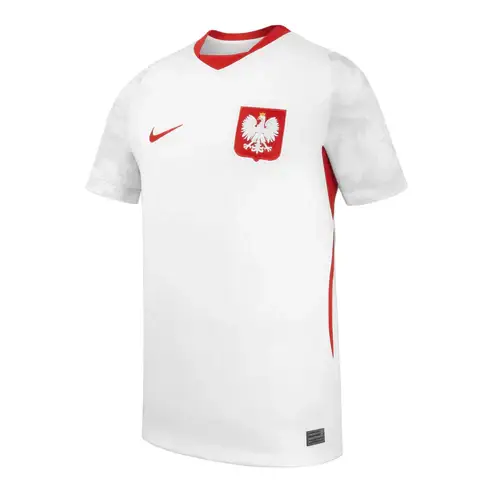
Poland’s football shirt is beautifully simple: a white shirt, red trim, and the White Eagle on the chest. The colours come straight from the Polish flag, and the eagle is the emblem of the Polish nation itself. It is a shirt that carries history in every thread, from the golden teams of the 1970s who stunned the world to the modern era of Robert Lewandowski. This is the story of the famous white shirt.
The White Eagle on the chest
The most important detail on any Poland shirt is not a sponsor or a design flourish. It is the eagle. The White Eagle has been the emblem of Poland for centuries, and it sits on the chest of the national team shirt as a symbol of the country itself. The shirt’s colours are the colours of the flag: white and red, with white dominating the home shirt and red providing the trim, the numbers, and the accents. The away shirt usually reverses the combination, but the home white shirt is the one supporters think of first. It is a clean, proud design, and it has barely changed in its essentials for decades. Other nations have experimented with bold patterns and unusual colours. Poland has never needed to. The white shirt and the eagle say enough.
The golden generation of 1974
Poland’s white shirt first became famous around the world at the 1974 World Cup in West Germany. Nobody expected much from the Poles, but they played some of the best football of the tournament. They beat Argentina and Italy in the first group stage, then beat Sweden and Yugoslavia in the second. Their only defeat came in the famous rain-soaked match against the hosts in Frankfurt, played on a flooded pitch, which West Germany won 1-0. Poland recovered to beat Brazil 1-0 in the third-place play-off, with Grzegorz Lato scoring the winner. Lato finished the tournament as top scorer with seven goals, and Kazimierz Deyna, the elegant playmaker, was recognised as one of the finest midfielders in the world. The 1974 team remains the benchmark for every Poland side since, and the white shirt they wore is one of the great shirts of World Cup history.
1982: third place again
Eight years later, Poland did it again. At the 1982 World Cup in Spain, the white shirt was back on the world stage, and the team finished third for the second time. Zbigniew Boniek, the brilliant forward who would go on to star for Juventus, scored a hat-trick against Belgium in the second group stage, one of the great individual performances in World Cup history. Poland drew with the Soviet Union to reach the semi-final, where they lost to eventual champions Italy, but they bounced back to beat France 3-2 in the third-place match. Two third-place finishes in three World Cups is a record most nations would envy, and it was achieved by teams wearing the same simple white shirt. The 1974 and 1982 shirts are now among the most sought-after retro national team shirts in football.
Olympic gold and the long wait
Poland’s golden era was not limited to the World Cup. At the 1972 Olympic Games in Munich, Poland won the football gold medal, beating Hungary 2-1 in the final, and they took silver four years later in Montreal. But after the 1980s, the white shirt disappeared from the biggest stages for a long time. Poland did not qualify for a World Cup between 1986 and 2002, and they did not reach a European Championship until 2008. When they co-hosted Euro 2012 with Ukraine, the white shirt was finally back at a major tournament on home soil, and the whole country turned out to support it. The long wait made supporters appreciate the shirt even more. It had never gone away, but it had been waiting for a team worthy of it.
The Lewandowski era
The modern era of the Poland shirt belongs to one man: Robert Lewandowski. The striker has scored more than 80 international goals, making him Poland’s all-time top scorer by a wide margin, and he has captained the side for years. His goals carried Poland to the quarter-finals of Euro 2016, their best ever result at a European Championship, where they lost to eventual champions Portugal on penalties. Lewandowski’s career has taken him from Borussia Dortmund to Bayern Munich and then to Barcelona, but he has always said that the white shirt of Poland means the most to him. The current Poland shirt is built around him, and around a new generation of players who grew up watching him. For collectors, the Lewandowski-era shirts, with his name and number on the back, are already modern classics.
The 2026 shirt: a preview
The Poland 2026 World Cup jersey keeps the formula that has served the team for decades: a clean white shirt with red trim and the White Eagle on the chest. It is a design that does not chase trends, because it does not need to. The white shirt looks as good today as it did in 1974, and that is the point of it. The shirt is made for supporters who want to wear the colours of the team, whether they are watching from the stands, from a fan zone, or from home. It is a shirt that works with jeans, with shorts, and with anything else in your wardrobe, because white goes with everything and the eagle gives it meaning. If you are looking for a national team shirt that will never go out of style, the Poland white shirt is one of the safest choices in world football.
Why the Poland shirt belongs in a collection
A Poland shirt is a piece of football history. It is the shirt of the 1974 team that beat Brazil and finished third in the world, of the 1982 team that did it again, and of the Lewandowski era that brought the white shirt back to the top of the game. It is also a shirt of remarkable simplicity. In a market full of busy designs and loud patterns, the white shirt with the red trim and the eagle stands out precisely because it does not try too hard. Whether you choose a retro version from the golden era or the current shirt, you are choosing a design that has been proven over fifty years.
If the white shirt has won you over, you can find the Poland 2026 World Cup jersey and the rest of the national team collection at the ElevenKick shop.

