
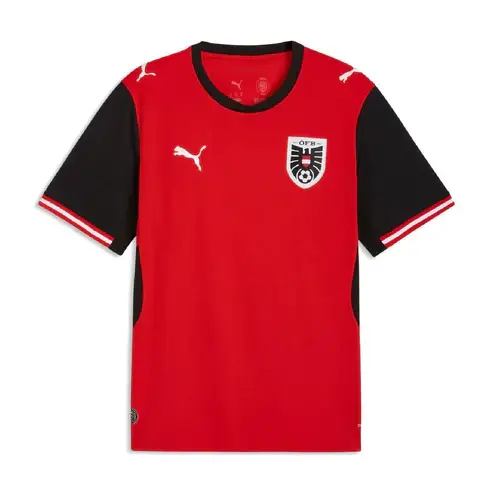
Some national team shirts are famous because of one tournament. Austria’s red shirt is famous because of almost a century of football history — from the elegant Wunderteam of the 1930s, to a World Cup third place in 1954, to a modern team that topped its group at Euro 2024 ahead of France and the Netherlands. The red shirt has been there for all of it, and it remains one of international football’s most understated classics.
The Wunderteam and the first great Austrian shirt
Austria’s football story begins early. The Austrian Football Association, the ÖFB, was founded in 1904, and the national team became one of the strongest in Europe in the early 1930s. That side, coached by Hugo Meisl, was known as the Wunderteam — the wonder team — and it played a quick, short-passing style that was years ahead of its time. Its star was Matthias Sindelar, known as “The Paper Man” for the lightness of his movement, one of the greatest players of his generation.
The Wunderteam beat Scotland 5-0, Germany 6-0 and Hungary 8-2, and reached the semi-finals of the 1934 World Cup, where they lost to the hosts and eventual winners, Italy. The shirts of that era were simple by modern standards — red, with a crest, and little else — but they carried a team that changed how football was played. For collectors, the Wunderteam is the beginning of the Austrian shirt’s story, and the reason the red shirt still carries weight today.
Red, white and the Austrian identity
Austria’s home shirt is red. It has been red for generations, paired most often with white shorts and red socks, echoing the colours of the Austrian flag. The away shirt is usually white, sometimes with black trim. The design has stayed deliberately simple: a red shirt, a crest, and the confidence that the colour itself is enough. In an era when many national teams experiment with bold patterns, Austria’s restraint is part of the appeal.
The crest itself tells the story. It carries the Austrian eagle, a symbol of the country, and it sits over the heart on a shirt that has represented a small nation with a large football history. When Austrian fans fill the Ernst-Happel-Stadion in Vienna, the stands are a wall of red, and the shirt is the thing that ties the crowd to the team.
1954: the best World Cup finish
Austria’s greatest World Cup result came in Switzerland in 1954, when the team finished third — still the country’s best ever finish at the tournament. Austria beat the hosts Switzerland 7-5 in a famous quarter-final, a match that remains one of the highest-scoring games in World Cup history, before losing to West Germany in the semi-final. In the third-place play-off, Austria beat the defending champions Uruguay 3-1 to take the bronze medals.
The players of 1954 wore the red shirt with pride, and the third-place finish gave the shirt a permanent place in Austrian football history. It is a reminder that Austria, for all its size, has produced teams that could stand with the very best. Every Austrian shirt since then has carried that 1954 achievement in its background, even if the shirt itself has stayed simple.
The long wait and the modern revival
After 1954, Austria spent decades in the international wilderness. The team failed to qualify for tournament after tournament, and the red shirt became a symbol of unfulfilled promise. Austria co-hosted Euro 2008 with Switzerland, which brought the team back to a major tournament on home soil, but the side went out in the group stage. Euro 2016 brought another group-stage exit.
The revival came under modern management, and it has been built on a generation of players who play at the highest level of European club football. David Alaba, the captain and the country’s most famous modern player, has been the face of the team. Around him, players like Marcel Sabitzer, Konrad Laimer, Marko Arnautović and Christoph Baumgartner have given Austria a side that presses hard, runs hard, and plays with a clear plan. The red shirt now belongs to a team with an identity again.
Euro 2024: topping the group of death
Austria’s best modern tournament came at Euro 2024 in Germany. Drawn in a group with France, the Netherlands and Poland, Austria were expected to struggle. Instead, they won the group, beating Poland and the Netherlands and finishing above both France and the Netherlands. It was one of the stories of the tournament, and the red shirt was at the centre of it.
Austria’s run ended in the round of 16, losing 2-1 to Turkey in Leipzig, but the impression the team left was lasting. They had played brave, attacking football, and they had done it in a shirt that looked as sharp as the football. For many fans watching from outside Austria, Euro 2024 was the first time they had really noticed the Austrian shirt — and they liked what they saw.
The 2026 shirt and the road ahead
As the 2026 World Cup approaches, the Austria shirt arrives with real momentum behind it. The current home shirt keeps the classic red, with a clean modern cut and the crest over the heart. It is a shirt that connects the Wunderteam of the 1930s, the bronze medallists of 1954, and the group winners of Euro 2024 into a single line of red. For collectors, the 2026 shirt is a natural addition to a World Cup collection, and for Austrian fans it is the latest chapter of a shirt they have worn with pride for generations.
If you are choosing an Austria shirt, the red home shirt is the one to buy first. It is the shirt of the team’s identity, the shirt of Euro 2024, and the shirt that has represented Austria since the days of the Wunderteam. The white away shirt is a good second choice, especially for fans who like a cleaner, simpler design.
Why the Austria shirt belongs in a collection
The Austria shirt is a collector’s shirt for a particular kind of fan: the one who values history over hype. It is not the shirt of a team that wins every tournament, but it is the shirt of a team that helped invent modern football, that finished third at a World Cup, and that topped a Euro group of death. It is a shirt with a story that rewards anyone who takes the time to learn it.
For fans building a World Cup collection, the Austria shirt also fills an important gap. Every collection needs the red shirts — Spain, Portugal, Belgium — and Austria’s red is one of the oldest and most honest of them all. It is a shirt that looks good on its own, and even better when you know what it stands for.
You can find the Austria 2026 World Cup jersey at the ElevenKick shop, along with the rest of our national team collection.

